
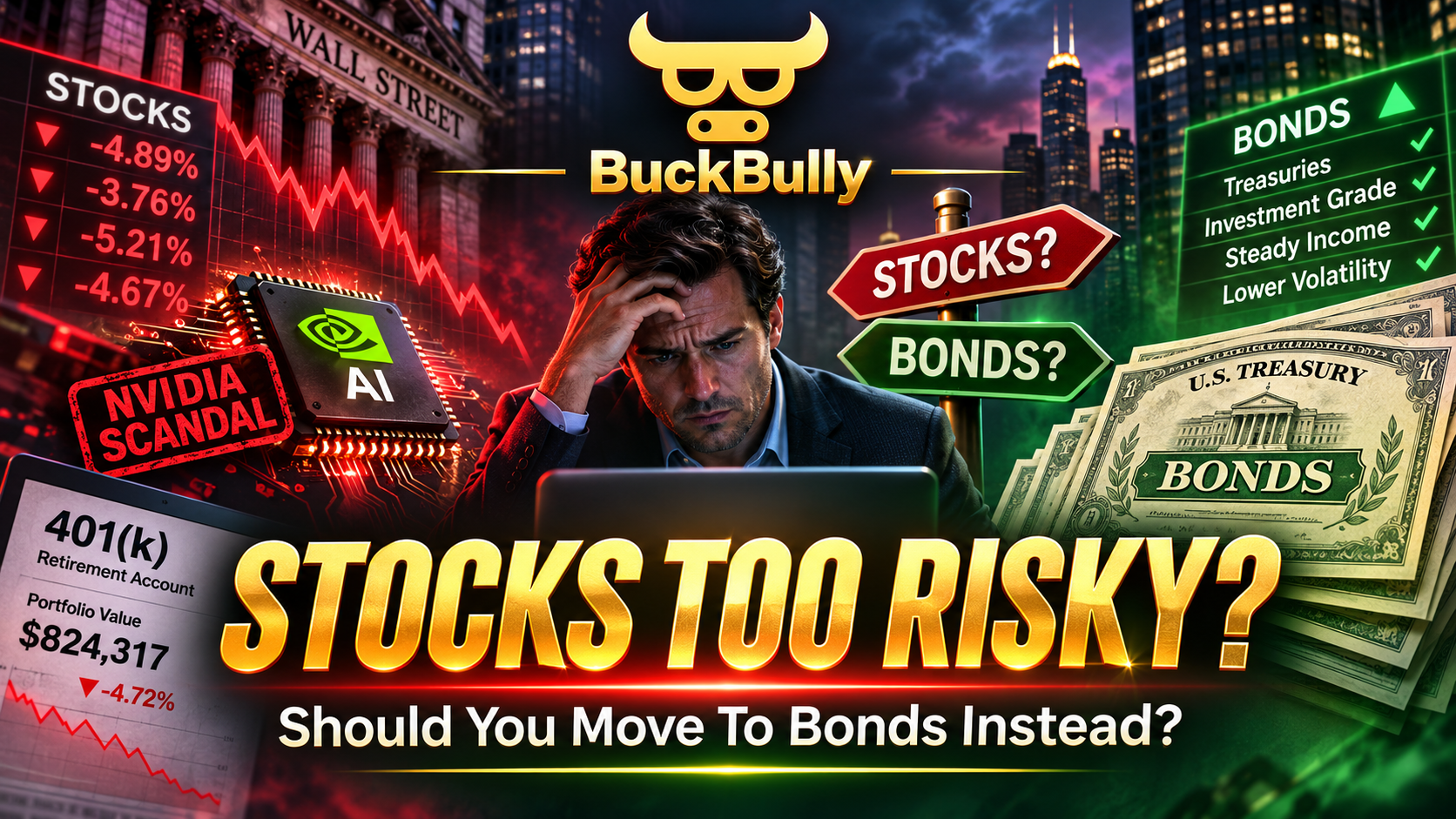
CAN YOU STILL TRUST THE STOCK MARKET?
Nvidia’s corporate scandal has rattled Wall Street and exposed an uncomfortable truth: Your retirement savings may be vulnerable to companies you never knowingly invested in.
Should investors abandon stocks for bonds, or would that introduce an entirely different risk?
Nvidia fallout 401(k) exposure Stocks vs. bonds Interactive analysisFigures are dated reporting snapshots, not live prices. Source: AP, Axios and CNN reporting.
What happens when corporate scandal reaches your retirement account?
An investor can spend decades saving diligently, avoiding unnecessary debt and contributing to a retirement account, only to see part of that wealth threatened by events completely outside their control.
Nvidia’s November turmoil illustrates how personal conduct, governance questions, national-security concerns and investor psychology can intersect. Reports of relationships involving former CEO Jensen Huang triggered scrutiny and investigations. Huang’s resignation on November 12 compounded concerns about leadership succession and the company’s future.
The fact of a resignation does not establish every allegation, and the financial effects cannot be attributed to the scandal alone. Concerns about AI spending, valuations and future demand were already weighing on technology stocks.
How one company can send shockwaves through Wall Street
1. Company shock
Leadership instability, legal uncertainty and weaker confidence lead investors to reassess Nvidia’s future earnings and valuation.
2. Index contagion
A heavily weighted technology leader declines, pressuring stock indexes, ETFs, growth funds and related technology shares.
3. Retirement impact
Investors holding diversified funds may discover that a substantial portion of their savings is tied to the same companies.
How Nvidia’s crisis unfolded
Reference point: Nvidia’s record high
Nvidia reaches the peak used in subsequent reporting to measure its approximately 30% decline by mid-November.
Investigation and public scrutiny
Reports of Huang’s personal relationship and possible foreign intelligence concerns intensify. Nvidia confirms it is investigating reports of a foreign intelligence effort targeting Huang.
Analysts reassess Nvidia
Baird downgrades Nvidia and Morgan Stanley removes it from its Top Pick list amid governance uncertainty and concerns about future AI infrastructure spending.
Jensen Huang resigns
The company’s longtime CEO departs. CFO Colette Kress becomes interim CEO. Nvidia shares fall approximately 4.3% during the trading session.
Technology-sector anxiety persists
Chip and AI-linked companies continue experiencing volatility as investors weigh Nvidia’s succession plans and the sustainability of AI spending.
The retirement-savings debate
Attention turns toward the indirect exposure held in 401(k) accounts and other retirement investments. Investors question whether diversification is protecting them enough.
How exposed is your 401(k) to Nvidia?
Enter your portfolio balance, your estimated Nvidia exposure and the hypothetical decline. The calculator isolates Nvidia’s direct contribution and assumes all other holdings remain unchanged.
Estimated direct Nvidia impact
$2,400Hypothetical value reduction attributable to Nvidia alone.
Portfolio after isolated decline $97,600 Total account percentage decline 2.40%How concentrated exposure magnifies losses
Modeled losses for the balance and Nvidia decline selected above. Not observed returns.
Is it time to move your money into bonds?
Bonds can reduce dependence on corporate earnings, but the word “safe” requires context. A short-term Treasury bill held to maturity is fundamentally different from a long-duration corporate bond fund.
Stocks: ownership and growth
Stocks represent ownership in businesses and historically provide opportunities for long-term capital appreciation.
Major risks: business failures, market crashes, changing valuations, governance problems and permanent capital losses.
Potential strength: growth that may outpace inflation over decades.
Bonds: income and stability
Bonds are loans to governments or companies. They can provide predictable income and, depending on the type, lower volatility.
Major risks: interest-rate fluctuations, inflation, default and liquidity.
Potential strength: more predictable cash flows and portfolio diversification.
| Investment | Principal risk | Main benefit | Consideration |
|---|---|---|---|
| Individual stocks | High | Growth potential | Company-specific risk |
| Diversified stock funds | Market risk | Broad ownership | Index concentration |
| Short-term Treasuries | Low credit risk | Predictable maturity | Reinvestment and inflation risk |
| Intermediate bond funds | Rate and credit risk | Income and balance | Market value fluctuates |
| Long-term bonds | High rate sensitivity | Longer fixed payments | Large price swings possible |
| TIPS | Market-price risk | Inflation adjustment | Can fluctuate before maturity |
Build your own stocks-and-bonds portfolio
Compare three traditional allocations or select your own. The model starts with $100,000, but you can change the amount and forecast horizon.
Your allocation
Choose a market environment
Illustrative portfolio outcome
$0What happens when both stocks and bonds fall?
Bonds are not guaranteed to rise when stocks fall. Inflation shocks and rising interest rates can cause both asset classes to decline together.
Traditional stock crash
A hypothetical one-year event:
Illustrative market shock, not actual historical returns.
Inflation and rate shock
A hypothetical one-year event:
Illustrative market shock, not actual historical returns.
How much can rising rates hurt bond prices?
Bond duration measures sensitivity to interest-rate changes. Use the sliders to estimate the effect of a sudden change in yield.
Rule of thumb: approximate bond-price change = -duration × yield change.
Estimated bond-price response
-6.0%First-order approximation only. Actual returns depend on convexity, credit spreads, interest income and the shape of the yield curve.
Wall Street has faced crises before
Corporate scandals are only one source of market danger. Economic recessions, banking failures, pandemics and inflation can create entirely different market reactions.
The dot-com crash
Technology valuations collapsed after the internet-investment boom. Speculative growth stocks suffered especially severe losses.
The global financial crisis
Banking failures and a housing collapse caused a steep equity bear market. High-quality government bonds provided diversification in parts of the crisis.
The pandemic crash
Stocks fell rapidly during widespread shutdowns, followed by a powerful rebound. Investors who sold during the panic risked missing the recovery.
Inflation hits stocks and bonds
Rapid interest-rate increases hurt both equities and many bond funds, challenging traditional diversification.
The AI concentration question
Nvidia’s leadership upheaval exposes how a small number of powerful technology companies can influence broad indexes and retirement portfolios.
Should you sell, rebalance or stay invested?
🛡️ Preserve capital
For savings needed soon, examine Treasury bills, insured deposits and other low-volatility options.
Priority: access to money and principal protection rather than maximum growth.
⚖️ Reduce concentration
For retirement portfolios, examine the weight of AI and technology stocks, diversification and bond duration.
Priority: balance risks rather than make an all-or-nothing bet.
📈 Long-term growth
Investors with many years before retirement may choose to retain meaningful stock exposure despite volatility.
Priority: growth potential and an ability to withstand market declines.
Before moving your entire 401(k), ask:
1. How many years remain until I need this money?
2. How much of my retirement account is invested in the same five or ten companies?
3. What would a 20%, 30% or 40% stock-market decline mean for my actual retirement plan?
4. Am I considering bonds for reliable income, reduced volatility or simply because I am afraid?
5. Could a diversified allocation better match my goals than selling all stocks at once?
Maybe the issue isn’t the stock market. Maybe it’s how much we trust it.
The investing world celebrates market gains and record-breaking companies. But moments like Nvidia’s scandal remind us that behind every ticker symbol are executives, boards, business decisions and risks investors cannot completely predict.
That doesn’t mean stocks are inherently untrustworthy or that bonds are a guaranteed escape from risk.
It means investors should examine whether their retirement accounts are diversified in name only. A portfolio holding dozens of funds may still be heavily concentrated in the same large technology companies.
A long-term financial plan should survive changes in executive leadership, market corrections and economic cycles without depending on the flawless behavior of any one company.
The real objective is to own a portfolio whose risks you understand and whose volatility you can afford to withstand.
For some investors, that may mean more high-quality bonds. For others, it may mean less concentration in technology shares, or simply maintaining a sensible long-term investment strategy.
Sources and further reading
Reporting snapshot: November 15, 2026. Market figures and headlines may change after publication.
Associated Press — Nvidia leadership developments
Axios — Nvidia and retirement-account exposure
CBS News — Nvidia’s impact on 401(k) funds
SEC Investor.gov — Bond fund risks
TreasuryDirect — Treasury securities
This content is educational commentary, not individualized investment advice. All model outcomes are hypothetical and exclude fees, taxes and other real-world factors.