
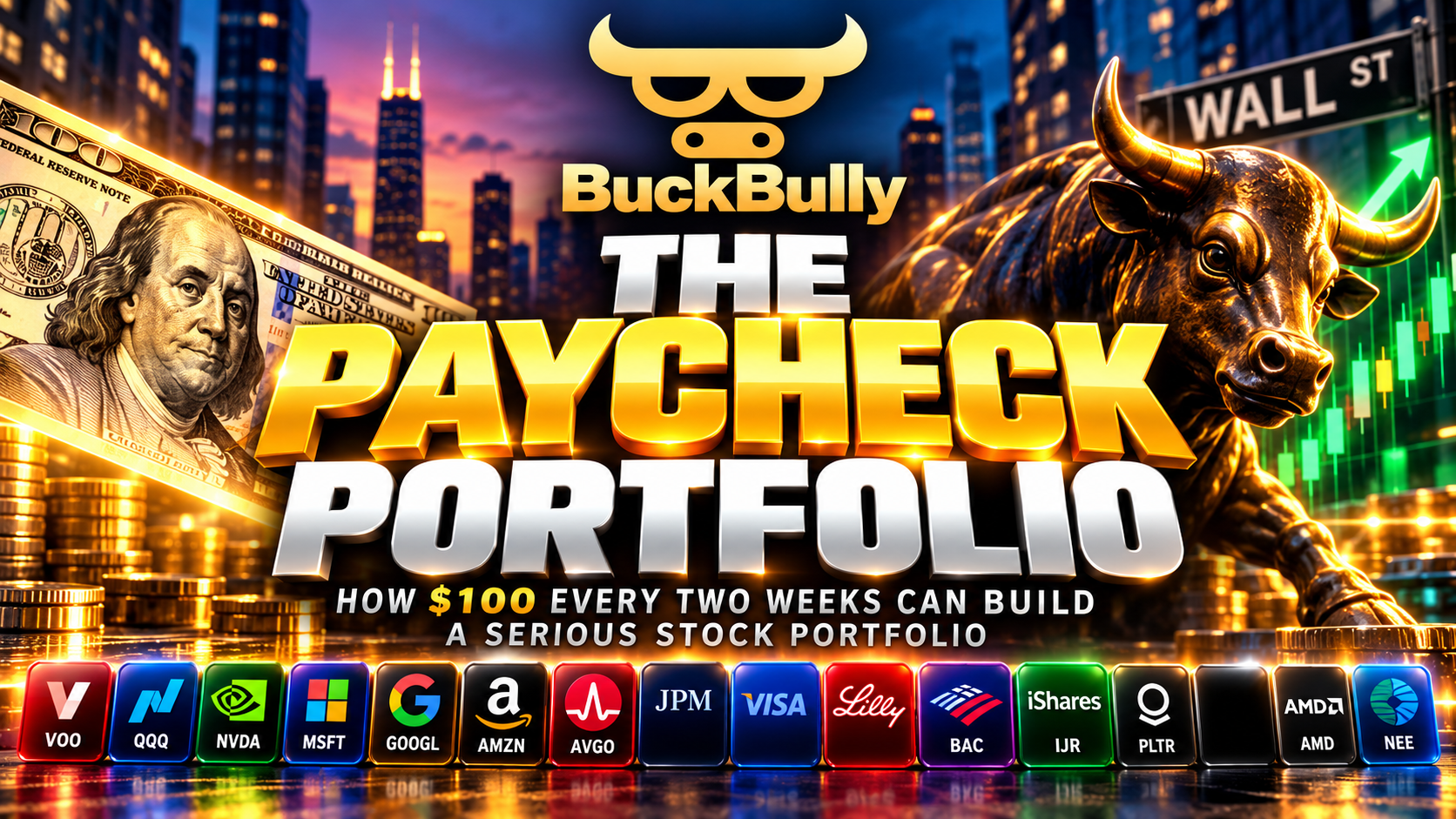
How $100 Every Two Weeks Can Build a Serious Stock Portfolio
ETFs. AI. Technology. Banking. Healthcare. Small Caps. Infrastructure. Fractional Shares.
You don’t need thousands of dollars to start building a diversified stock portfolio.
You don’t even need enough money to purchase one full share.
Fractional-share investing has changed the mathematics for smaller investors. Instead of waiting until you can afford an entire share of a high-priced stock, several investing platforms allow eligible stocks and ETFs to be purchased by dollar amount.
That makes our strategy possible:
$100 every two weeks.
That’s 26 contributions per year — $2,600 annually.
Instead of putting the entire $100 into one company, the Paycheck Portfolio spreads money across broad-market ETFs, artificial intelligence, technology, banking, payments, healthcare, small-cap companies and energy while maintaining cash for future opportunities.
The objective isn’t to find one stock that makes us rich.
It’s to steadily accumulate ownership across different parts of the economy.
The $100 Paycheck Portfolio
| Investment | Target | Every 2 Weeks | Purpose |
|---|---|---|---|
| VOO | 25% | $25 | S&P 500 foundation |
| QQQ | 10% | $10 | Nasdaq / technology |
| Nvidia (NVDA) | 8% | $8 | AI computing |
| Microsoft (MSFT) | 7% | $7 | AI / cloud / software |
| Alphabet (GOOGL) | 6% | $6 | AI / search / cloud |
| Amazon (AMZN) | 5% | $5 | Cloud / AI / commerce |
| Broadcom (AVGO) | 5% | $5 | AI chips / networking |
| JPMorgan (JPM) | 5% | $5 | Banking |
| Visa (V) | 4% | $4 | Digital payments |
| Eli Lilly (LLY) | 4% | $4 | Healthcare / growth |
| Bank of America (BAC) | 3% | $3 | Banking |
| IJR | 3% | $3 | U.S. small-cap ETF |
| Palantir (PLTR) | 3% | $3 | AI software |
| AMD | 2% | $2 | AI / semiconductors |
| NextEra Energy (NEE) | 2% | $2 | Energy / infrastructure |
| USD Cash | 8% | $8 | Dry powder |
| TOTAL | 100% | $100 |
These percentages are portfolio targets. They don’t necessarily mean an investor needs to execute 15 different orders every payday.
Fractional shares and recurring investments can make maintaining the targets considerably easier.
Fractional Shares Change the Game
Imagine a stock trading at $500.
A beginning investor might look at the price and think:
“I can’t afford that stock.”
But if the brokerage supports fractional shares in that security, an investor might purchase just $5 worth.
At a hypothetical $500 share price, $5 buys approximately 0.01 share.
The investor participates proportionately in the stock’s gains and losses without needing $500 upfront.
This changes the way smaller portfolios can be constructed.
Instead of asking:
“How many shares can I afford?”
We’re asking:
“How many dollars do I want invested in this business?”
Platforms Offering Fractional Shares
Fractional-share availability varies by brokerage. Eligible securities, minimum order amounts, recurring-investment features and other rules can also change.
But several major platforms make dollar-based investing possible.
Cash App
Cash App is one of the simpler ways for newer investors to understand fractional investing. It allows fractional purchases of eligible stocks and ETFs starting at $1 and offers automatic investing features.
Instead of purchasing an entire share of Nvidia, for example, an investor could potentially enter:
NVDA → $8
That’s particularly compatible with our $100 strategy.
Investors should verify that each security they want is available before attempting to reproduce the entire portfolio on Cash App.
Fidelity
Fidelity offers fractional purchases of eligible U.S. stocks and ETFs starting at $1 and supports recurring investments, making it especially well suited to a biweekly approach.
Robinhood
Robinhood supports dollar-based fractional investing in eligible stocks and ETFs, also with a low minimum.
M1
M1 is interesting for percentage-based strategies because its portfolio approach can make target allocations and recurring investing intuitive.
Interactive Brokers
Interactive Brokers Fractional Trading
Interactive Brokers provides fractional trading across a broad selection of eligible securities and offers more advanced investing tools for investors who eventually want them.
SoFi Invest
SoFi offers fractional investing in eligible securities and provides another accessible option for smaller accounts.
Charles Schwab
Schwab offers fractional investing through Stock Slices, although its eligibility rules differ from platforms offering fractional trading across a wider universe of stocks and ETFs.
The lesson isn’t that everyone should use the same brokerage.
It’s that share price no longer necessarily determines whether an investor can participate.
38% in ETFs: Build the Foundation First
Our portfolio now contains three different ETFs:
VOO — 25%
QQQ — 10%
IJR — 3%
That’s 38% of the entire portfolio in diversified funds.
Each has a different job.
VOO — 25%: The Foundation
VOO tracks the S&P 500.
Rather than trying to identify which large American company will dominate 10 or 20 years from now, we’re purchasing exposure to hundreds of major businesses.
That’s why VOO receives the portfolio’s largest allocation.
The philosophy is straightforward:
We don’t need every stock pick to be right when a large part of the portfolio owns the market.
QQQ — 10%: Turn Up the Growth
QQQ provides an intentional technology and growth tilt.
It gives us additional exposure to many large Nasdaq-listed companies.
There is substantial overlap between QQQ, VOO and several individual companies in our portfolio.
That’s intentional.
The ETFs provide diversified exposure.
Our individual stocks tell the portfolio where we want additional exposure.
IJR — 3%: Don’t Forget the Small Companies
This is the newest addition to the strategy.
Rather than leaving the small-cap category undefined, we’re using the iShares Core S&P Small-Cap ETF (IJR).
iShares Core S&P Small-Cap ETF — IJR
IJR tracks the S&P SmallCap 600 Index, providing diversified exposure to smaller U.S. companies. Its current expense ratio is just 0.06%.
Why add it?
Because our portfolio otherwise leans heavily toward enormous companies.
Nvidia.
Microsoft.
Alphabet.
Amazon.
JPMorgan.
These are giants.
IJR gives us exposure to another part of the economy.
Small companies can be more volatile and economically sensitive than established mega-caps, which is one reason we’re keeping the position at only 3%.
But it gives us something valuable:
Exposure to companies that haven’t become giants yet.
Instead of trying to predict which individual small company will become tomorrow’s winner, we’re buying a basket of them.
36% — AI and Technology
Artificial intelligence isn’t simply one industry.
AI requires an entire ecosystem:
Semiconductors → networking → data centers → cloud computing → software → applications → electricity.
Instead of attempting to identify one AI winner, we’re investing across several layers.
Nvidia — 8%
Nvidia receives our largest individual-stock allocation.
It represents the computing side of the AI buildout.
But even with strong conviction, we’re stopping at 8%.
Why?
Because a great company can still become a dangerous portfolio concentration.
Microsoft — 7%
Microsoft gives us exposure to enterprise software, cloud computing and AI services.
Its opportunity differs from Nvidia’s.
Instead of primarily supplying computing hardware, Microsoft can potentially integrate AI throughout products and services businesses already use.
Alphabet — 6%
Alphabet brings together search, advertising, cloud computing and artificial intelligence.
AI could strengthen some existing Alphabet businesses while simultaneously disrupting others.
That’s why we treat it as an investment opportunity rather than assuming its dominance is guaranteed.
Amazon — 5%
Amazon gives us AWS cloud infrastructure alongside e-commerce and other businesses.
Cloud computing makes Amazon another important component of the AI infrastructure story without relying entirely on semiconductor demand.
Broadcom — 5%
Broadcom adds networking and semiconductor infrastructure.
We’re now spreading the AI thesis across:
Computing
Networking
Cloud
Software
Applications
rather than putting the entire theme into one company.
Smaller AI Growth Positions
Palantir — 3%
PLTR gives us exposure to AI software and data analytics.
The position is deliberately smaller because it carries greater company-specific and valuation risk.
If Palantir becomes an enormous winner, 3% is enough to matter.
If we’re wrong, the rest of the portfolio survives.
AMD — 2%
AMD provides another semiconductor and accelerated-computing position.
Again, potential upside doesn’t automatically determine allocation.
The higher the uncertainty, the more carefully we control position size.
12% — Banking and Payments
Technology shouldn’t control the entire portfolio.
We also want exposure to the financial system.
JPMorgan — 5%
JPM provides exposure to banking, lending, investment banking and other financial services.
Bank of America — 3%
BAC gives us another major U.S. banking franchise without overloading the portfolio with numerous banks serving similar purposes.
Visa — 4%
Visa gives us exposure to payment infrastructure rather than another traditional bank.
Think of the distinction this way:
Banks manage and lend money.
Payment networks help move money.
Together, the three positions create a more balanced financial bucket.
4% — Healthcare
Eli Lilly — 4%
Innovation doesn’t only happen in technology.
Healthcare and pharmaceuticals provide another potential source of long-term growth.
LLY gives the portfolio exposure to that industry while reducing our dependence on technology companies.
2% — Energy & Infrastructure
NextEra Energy — 2%
This is also an indirect technology investment.
AI requires enormous amounts of computing.
Computing requires data centers.
Data centers require electricity.
NEE provides exposure to power and infrastructure while giving the portfolio a sector outside traditional technology.
8% — Keep Some Dry Powder
We deliberately don’t invest the entire $100.
Every two weeks:
$92 → Stocks and ETFs
$8 → USD Cash
After 26 contributions, approximately $208 will have gone into the reserve.
That money has a purpose.
It’s ammunition.
Markets correct.
Companies miss earnings expectations.
Entire sectors occasionally fall out of favor.
Cash means we don’t have to sell something else when opportunity appears.
Don’t Automatically Spend the Cash
Dry powder shouldn’t automatically be deployed because a stock falls 5%.
Let it accumulate.
When there’s a meaningful correction, ask:
Which high-quality investment is now significantly below its target allocation?
That’s different from asking:
Which stock fell the most?
Something becoming cheaper doesn’t automatically make it a better investment.
$100 Every Two Weeks
Our schedule remains deliberately boring.
Payday arrives.
$100 enters the portfolio.
Repeat two weeks later.
This is dollar-cost averaging—investing predetermined amounts at regular intervals rather than trying to identify the exact top or bottom of the market.
It doesn’t guarantee profits or eliminate losses.
What it does eliminate is the need to constantly answer an impossible question:
“Is today the perfect day to buy?”
Instead:
“Where does this paycheck’s $100 go?”
One Year of the Paycheck Portfolio
After 26 contributions:
| Investment | Annual Contribution |
|---|---|
| VOO | $650 |
| QQQ | $260 |
| NVDA | $208 |
| MSFT | $182 |
| GOOGL | $156 |
| AMZN | $130 |
| AVGO | $130 |
| JPM | $130 |
| Visa | $104 |
| LLY | $104 |
| BAC | $78 |
| IJR | $78 |
| PLTR | $78 |
| AMD | $52 |
| NEE | $52 |
| Cash | $208 |
| TOTAL | $2,600 |
These numbers represent contributions—not projected returns.
Investment performance could increase or decrease the actual portfolio value.
Don’t Confuse More Holdings With More Diversification
VOO already owns many of our individual companies.
QQQ owns several of them too.
Then we’re purchasing some of those stocks separately.
That’s intentional.
VOO = broad-market foundation
QQQ = growth tilt
IJR = small-company diversification
Individual stocks = conviction positions
We’re deliberately overweighting companies such as Nvidia, Microsoft and Alphabet relative to their normal market weight.
That could increase returns if our thesis works.
It can also increase losses if technology underperforms.
That’s the tradeoff.
Rebalance With Your Next Paycheck
Suppose Nvidia has an enormous run and grows from its 8% target to 12% of the portfolio.
Meanwhile IJR falls from 3% to 2%.
We don’t necessarily have to sell Nvidia immediately.
The next contribution can favor IJR and other underweight positions.
Future contributions gradually move the portfolio back toward its intended structure.
That’s contribution-based rebalancing.
It makes particular sense for a portfolio receiving new money every two weeks.
What Happens During a Market Crash?
This is where the strategy gets tested.
The natural reaction is often:
Stop buying.
But assuming the investor’s finances, time horizon and investment thesis remain intact, a declining market doesn’t automatically invalidate the plan.
Continue the scheduled contributions.
Identify underweight investments.
Allow the cash reserve to build.
During substantial corrections, deploy portions of that reserve deliberately.
We’re not trying to predict the exact bottom.
We’re making sure we still have capital when opportunities appear.
The Paycheck Portfolio Pyramid
🛡️ 38% — ETF Foundation
VOO 25% + QQQ 10% + IJR 3%
🤖 36% — AI & Technology
NVDA + MSFT + GOOGL + AMZN + AVGO + PLTR + AMD
🏦 12% — Banking & Payments
JPM + BAC + Visa
🧬 4% — Healthcare
Eli Lilly
⚡ 2% — Energy & Infrastructure
NextEra Energy
💵 8% — Opportunity Fund
USD Cash
TOTAL: 100%
Start With Dollars, Not Shares
This is the biggest lesson behind the Paycheck Portfolio.
A beginning investor sees an expensive stock and thinks:
“I can’t afford a share.”
Fractional investing changes the question:
“Can I afford $5 of that business every payday?”
One hundred dollars doesn’t look like much compared with a million-dollar portfolio.
Consistency changes the picture.
$100 every two weeks.
$2,600 contributed in one year.
$13,000 over five years.
$26,000 over ten years.
That’s before considering investment returns or dividends.
VOO provides the large-company foundation.
QQQ increases our growth exposure.
IJR brings America’s smaller companies into the portfolio.
AI and technology pursue growth.
Banks and Visa follow the flow of money.
Healthcare adds another innovation engine.
Energy helps power the infrastructure behind the digital economy.
Cash waits for opportunity.
Fractional shares make the entire strategy accessible without requiring enough money to purchase full shares.
The BuckBully Bottom Line
Building wealth doesn’t necessarily begin with a huge deposit.
It can begin with $100, a payday and a repeatable strategy.
Invest. Learn. Rebalance. Repeat.
And perhaps most importantly:
You don’t have to afford the whole stock to start owning part of the business.
Disclaimer: This article is for educational and informational purposes only and does not constitute financial, investment, tax or legal advice. Stocks and ETFs can lose value. Fractional-share availability, eligible securities, minimum purchases, fees and trading rules vary by brokerage and may change. The allocations above are hypothetical examples rather than individualized recommendations. Dollar-cost averaging and diversification do not guarantee a profit or protect against loss. Investors should research securities independently and consider their financial circumstances, risk tolerance, objectives and investment horizon before investing.