
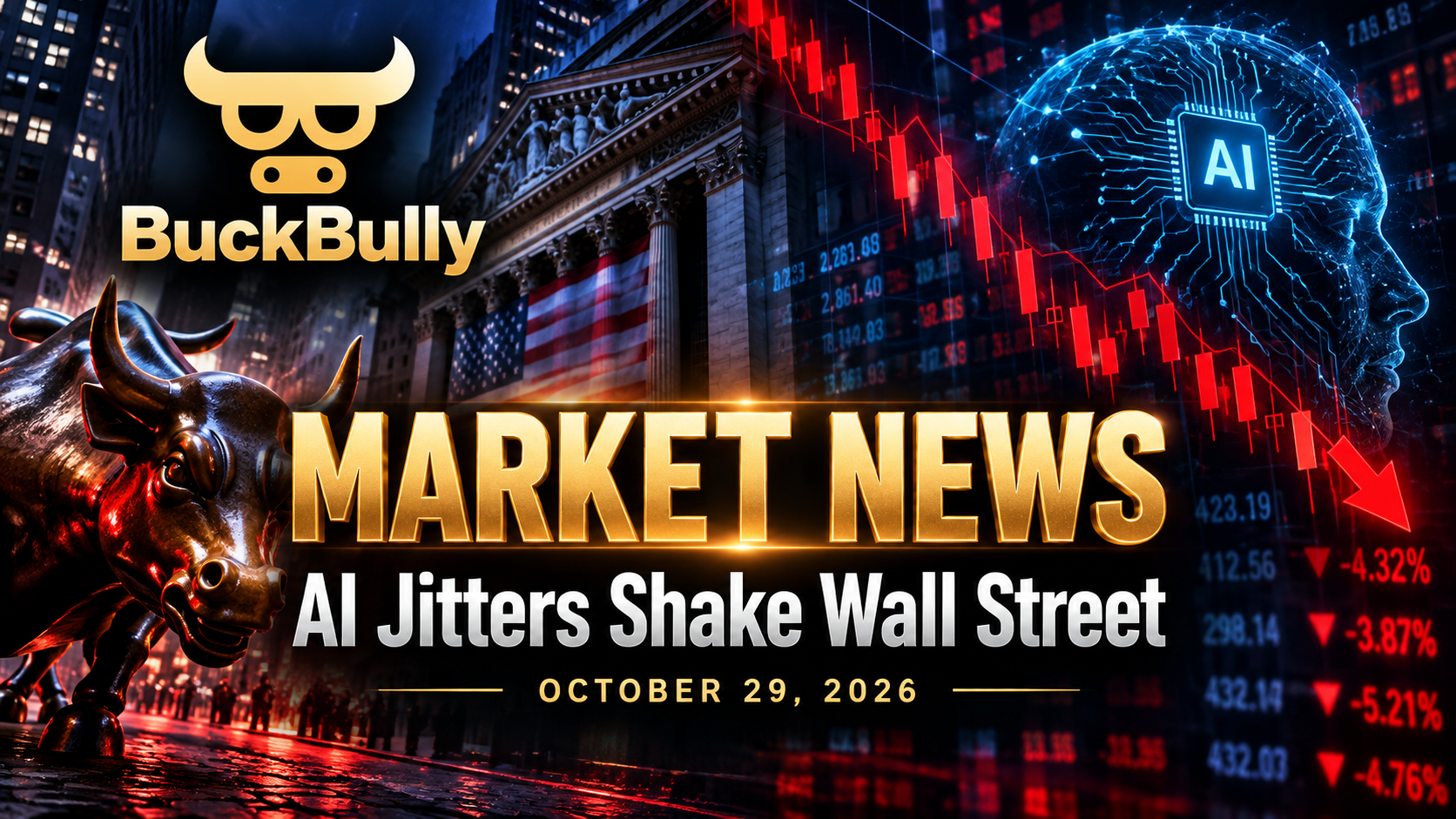
Wall Street Gets an AI Reality Check
Tech stocks take a hit as AI spending worries shake investors. Alphabet suffers a historic selloff, Amazon and Intel stumble after hours, and Wall Street starts looking beyond the technology giants.
Wall Street’s Wake-Up Call
It wasn’t the kind of Thursday Big Tech investors were hoping for. After three consecutive days of gains for the S&P 500, October 29 delivered a reminder that Wall Street still expects companies to turn their massive artificial intelligence investments into real profits.
Alphabet became the center of the storm, dropping nearly 13% after its earnings report raised fresh concerns about slowing growth, spending and cash generation. The Nasdaq finished down approximately 1.4%, while the Dow and S&P 500 recorded more modest losses.
But the story didn’t end with falling indexes. Most S&P 500 stocks actually advanced, and the small-cap Russell 2000 gained about 1%. That told us something important: investors weren’t necessarily abandoning the entire market. They were becoming more selective about where their money belonged.
How the Major Indexes Finished
Explore Index Performance
The technology-heavy Nasdaq was the biggest loser as Alphabet and other growth stocks faced selling pressure.
Bar compares absolute daily moves against a 2% reference range. It does not indicate investment risk or future performance.Five Companies, One Big Question: Will AI Spending Pay Off?
Artificial intelligence remains one of the biggest investment stories on Wall Street. But October 29 showed how different the reaction can be when investors compare spending commitments with actual business results.
Tap a company to see what mattered.
Alphabet (GOOGL) — Historic Selloff
Google’s parent company suffered a record one-day share-price decline, wiping out roughly $500 billion in stock market value. A disappointing revenue picture, particularly in the search business, combined with concerns over soaring AI infrastructure costs.
Why it matters: Strong cloud demand alone may not be enough when investors fear that the cost of developing and running AI products is growing faster than the rewards.
What we’re watching: Search advertising trends, AI monetization, capital expenditures and free cash flow.
Microsoft (MSFT) — Strong Results, Bigger Investment Questions
Microsoft reported better-than-expected results, demonstrating the strength of its enterprise software and cloud operations. But the scale of planned AI infrastructure spending and related financing also attracted attention.
Why it matters: Microsoft has a substantial existing customer base through which it can distribute AI services. The question is whether adoption, pricing and cloud demand can sustain the pace of investment.
What we’re watching: Azure growth, Copilot adoption, operating margins and AI investment returns.
Amazon (AMZN) — Cloud Spending Under the Microscope
Amazon added to the technology sector’s concerns after Thursday’s closing bell as investors digested earnings and rising investment requirements.
AWS remains central to Amazon’s AI strategy, but capital expenditures and the outlook for cloud growth are becoming increasingly important for its valuation.
What we’re watching: AWS revenue, infrastructure spending, operating income and free cash flow.
Intel (INTC) — Weak Outlook Sparks After-Hours Plunge
Intel shares plunged in extended trading after the company issued a disappointing fourth-quarter revenue outlook.
For investors, the reaction demonstrated how little patience remains for semiconductor businesses facing uncertain growth prospects or difficult competitive conditions.
What we’re watching: Gross margins, manufacturing progress, foundry demand and next-quarter revenue.
Meta (META) — Can AI Deliver Better Advertising Returns?
Meta’s earnings and infrastructure spending plans kept the AI investment debate in focus. Advertising performance, automated recommendations and the company’s ability to use AI to improve engagement remain important strengths.
Unlike some struggling technology names, Meta finished the October 29 regular trading session higher.
What we’re watching: Advertising revenue, engagement, AI-driven efficiency and spending guidance.
Where Did Investors Find Strength?
Technology weakness dominated the headlines, but the market beneath the surface was more resilient. Small-cap companies, selected financial stocks and health care names attracted interest.
Interactive Sector Focus
Technology: Under Pressure
Large technology stocks faced concentrated selling. Investors questioned the balance between AI-related revenue opportunities and the cost of pursuing them.
Watch: Earnings guidance, cash flow and whether weakness spreads beyond the largest companies.
Our read: A weak Nasdaq alongside a rising Russell 2000 suggests a rotation away from some crowded mega-cap positions, rather than a uniform market retreat. Whether that rotation can continue is a question for upcoming trading sessions.
The Fed Holds Steady — But Inflation Still Matters
The Federal Reserve held its benchmark interest-rate range unchanged at 3.75%–4.00% on October 28. The following day, investors continued digesting that decision alongside fresh economic data.
Held unchanged at the October meeting.
Reported annualized real economic growth in the third-quarter advance estimate.
September annual reading; price pressures remained elevated.
Approximate October 29 closing yield.
Stronger economic growth can support business earnings, but persistent inflation can also keep borrowing costs high. That creates a challenging environment for companies depending heavily on future growth or expensive financing.
For the market, the next challenge is balancing solid economic activity against the possibility that interest rates remain restrictive longer than some investors would prefer.
AI Spending: Opportunity or Warning Sign?
Not every company investing in AI faces the same risks. Use our scenario explorer to see how different combinations of spending, cash flow and demand change the investment discussion.
Choose a Company Profile
Stronger Financial Flexibility
A profitable company with recurring revenue and robust cash flow may be better equipped to support AI spending through an economic slowdown.
Primary test: Can new AI revenue justify continued capital investment without significant damage to margins?
How We’re Reading October 29
Our market meter organizes the day’s major themes into areas of possible opportunity and risk. It is an editorial assessment, not a predictive model.
Selective opportunity: established businesses with durable demand and cash generation may deserve closer attention after sharp declines.
Illustrative editorial scores as of October 29, 2026. Higher numbers reflect more attractive research conditions in our framework, not a calculated probability of profit.BuckBully Market Watch: Five Things We’re Watching
The market’s next direction will depend on how investors process the earnings news and whether selling remains concentrated or becomes more widespread.
- Alphabet’s follow-through: Watch whether the stock stabilizes after its record decline or selling pressure continues.
- Amazon and Intel’s next session: Their after-hours earnings reactions may influence the wider technology sector.
- Nasdaq recovery: The 26,000 region is a nearby round-number reference, not a proven technical support level.
- Small-cap strength: Watch whether the Russell 2000 continues outperforming as money rotates away from mega-cap technology.
- Inflation and bond yields: Persistently elevated rates could keep pressure on expensive growth stocks and heavily indebted businesses.
Our Bottom Line
October 29 was a reality check for the AI trade, but not necessarily a rejection of artificial intelligence as a long-term opportunity.
Companies are spending enormous amounts building the infrastructure that could shape the next generation of technology. Investors are now demanding clearer evidence that those investments will produce sustainable revenue, profitability and free cash flow.
The more interesting development may be happening outside the biggest tech names. With many individual stocks advancing even as the major indexes fell, the market showed that opportunity and risk can exist side by side.