
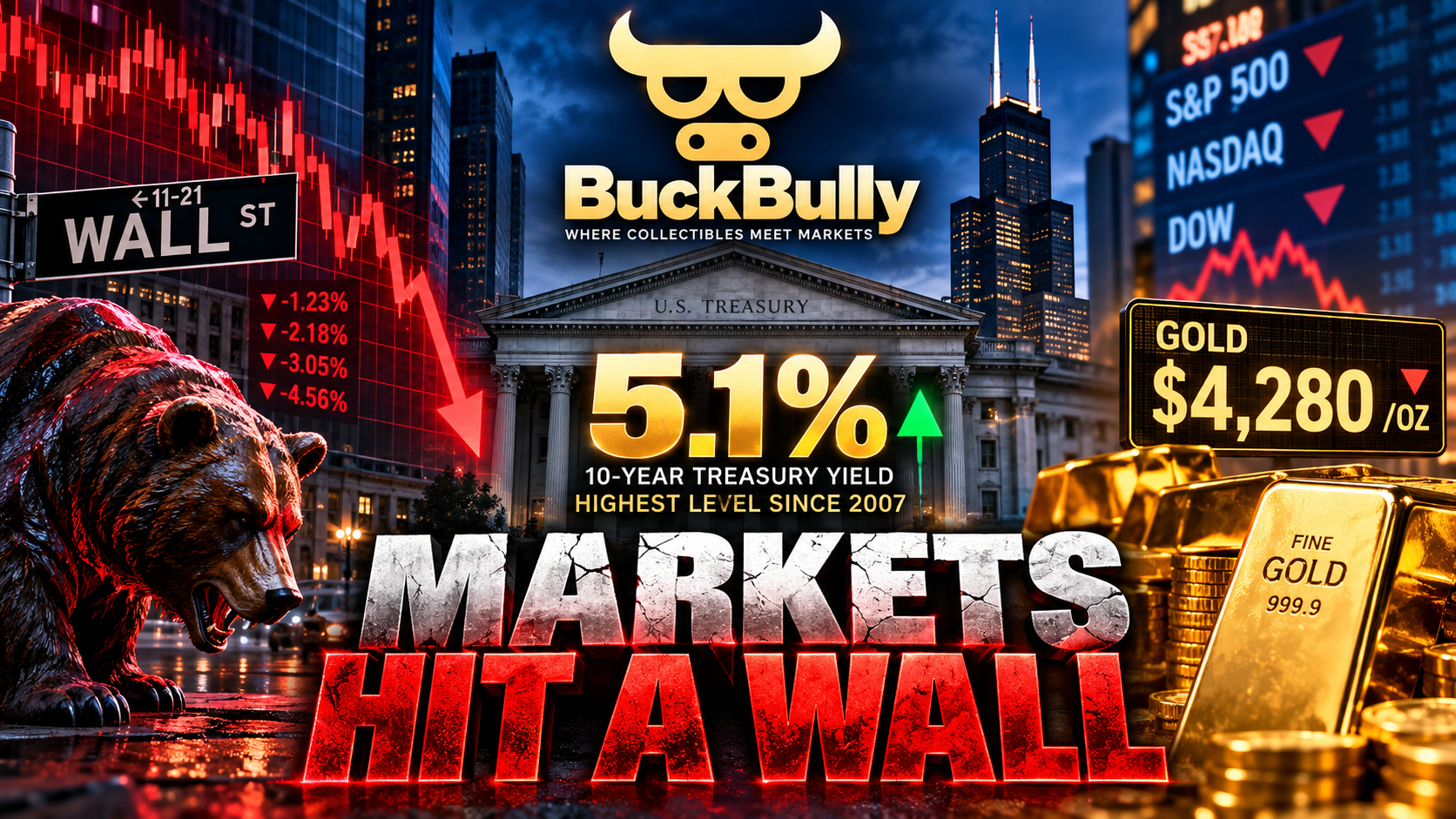
Treasury Yields Surge, Stocks Slide and Gold Retreats
Wall Street received another reminder Wednesday that a strong economy isn’t always good news for financial markets.
Stocks came under pressure as Treasury yields surged, gold retreated from its recent highs and investors digested surprisingly strong U.S. economic data. The message coming from markets is becoming increasingly clear: economic growth remains strong, but that strength could keep inflation — and interest rates — elevated longer than investors would like.
For investors, collectors and anyone watching where money is moving, September 23 offered plenty to unpack.
Treasury Yields Are Back in the Driver’s Seat
The biggest story hanging over markets is the renewed surge in Treasury yields.
The 10-year Treasury yield climbed above 5%, returning to territory not seen in roughly two decades. Rising yields create competition for stocks because investors can earn increasingly attractive returns from government debt without taking on the same risks associated with equities.
Higher yields can also increase borrowing costs throughout the economy — from mortgages and auto loans to business financing.
That’s especially important for growth and technology companies. Much of their valuation depends on profits expected years into the future, and those future earnings become less valuable in today’s dollars as interest rates rise.
The result has been renewed pressure on the stock market, particularly the technology-heavy Nasdaq.
Strong Economic Data Creates a Wall Street Problem
Normally, stronger economic activity sounds bullish.
Right now, Wall Street isn’t so sure.
S&P Global’s September flash U.S. Composite PMI jumped to 58.4, up from 56 in August and well above economists’ expectations of 55.2. Services activity climbed to 58.7 while manufacturing improved to 57.0.
Those are impressive numbers.
The problem is inflation.
S&P Global also reported intensifying supply-chain delays and sharply higher input costs. Businesses are dealing with higher fuel and transportation expenses while strong demand gives some companies more ability to raise prices.
That creates a strange market environment:
Good economic news can become bad market news if investors believe it means interest rates must stay higher for longer.
That’s one of the most important trends to watch heading toward the fourth quarter.
Gold Gets Knocked Back Toward $4,300
Gold wasn’t immune to Wednesday’s moves.
Spot gold dropped toward $4,280 per ounce following the stronger-than-expected economic data. Later readings from Kitco showed gold around $4,287, down roughly 1.6% on the session.
That decline makes sense in the short term.
Gold doesn’t pay interest. When Treasury yields rise sharply and the dollar strengthens, holding interest-bearing assets can become more attractive relative to precious metals.
But one down day doesn’t necessarily erase the bigger gold story.
Gold remains dramatically elevated compared with historical levels, and analysts continue debating whether sovereign buying, inflation concerns, geopolitical risk and demand for alternative stores of value can outweigh the pressure created by high real interest rates.
For collectors and precious-metals buyers, $4,300 is becoming an important psychological area to watch.
Housing Is Feeling the Interest-Rate Squeeze
The bond-market story reaches far beyond Wall Street.
Homebuilders are warning that affordability remains a serious obstacle as buyers struggle with the combination of high home prices and elevated borrowing costs. Lennar CEO Stuart Miller recently said buyers are stretching their finances considerably to purchase homes, while Bank of America analysts have also pointed to weak housing demand caused by affordability pressures.
Yet big investors aren’t abandoning housing.
Berkshire Hathaway has been increasing its exposure to the sector even as major builders warn about the difficult environment.
That creates an interesting divergence: today’s consumer is struggling with affordability while some long-term investors are still positioning around America’s persistent housing shortage.
The Market’s New Tug-of-War
The market appears caught between two powerful forces.
On one side is an economy that continues to demonstrate impressive resilience. Businesses are expanding, manufacturing activity is improving and services remain strong.
On the other side are inflation pressures and historically high Treasury yields.
That means investors may increasingly have to stop asking simply whether the economy is growing and start asking:
How much growth can the economy handle before inflation forces interest rates even higher?
That’s a much different market than the easy-money environment investors became accustomed to during much of the previous decade.
What We’re Watching Next
Treasury yields remain the first number to watch. If the 10-year continues pushing higher above 5%, expensive growth stocks could face additional valuation pressure.
Gold’s battle around the $4,300 level is another key signal. A stabilization despite elevated yields could suggest underlying demand remains strong, while a deeper decline could indicate that the combination of higher rates and a stronger dollar is finally gaining leverage over the precious-metals rally.
Housing deserves attention as well. Mortgage rates and Treasury yields could further squeeze affordability if rates remain elevated.
And finally, watch incoming inflation and employment numbers. Strong economic reports aren’t automatically bullish anymore. Every hot data release potentially changes expectations about where interest rates go next.
BuckBully Bottom Line
It’s not about one bad headline.
It’s about the market adjusting to the possibility that higher interest rates may be sticking around.
Stocks are confronting surging Treasury yields. Gold is testing whether its historic rally can withstand those same yields. Homebuyers are being squeezed by borrowing costs. Meanwhile, economic activity remains surprisingly strong.
That’s the contradiction defining today’s market.
The economy isn’t flashing recession.
It’s flashing strength.
And right now, Wall Street may be more worried about too much strength than too little.
BuckBully Market Watch — Where Collectibles Meet Markets
Market commentary is for informational purposes only and is not financial advice.