

Bitcoin Tumbles, Stocks Retreat, and Wall Street Faces a Reality Check
Crypto takes the biggest hit as leveraged traders get crushed, Treasury yields pressure investors, and Wall Street struggles to find its footing. Is this another buying opportunity or the beginning of a deeper market correction?
Wednesday delivered a reminder that financial markets don’t move in a straight line. After periods of optimism surrounding digital assets, artificial intelligence, and economic growth, investors found themselves navigating another wave of selling pressure across cryptocurrencies and traditional equities.
Bitcoin slipped toward the $83,000 mark, Ethereum experienced an even steeper percentage decline, and cryptocurrency-related stocks joined the retreat. Meanwhile, the S&P 500, Nasdaq, and Dow Jones Industrial Average all moved lower.
For investors watching both Wall Street and the digital asset market, Wednesday’s message was clear: When borrowing costs rise, liquidity tightens, and uncertainty increases, even the most popular investments can lose momentum.
Editor’s note: The market figures below are the reported Wednesday snapshots supplied for this article. They are not independently verified closing prices, and the figures should be checked against the final market data before publication.
1. Market scoreboard: Red across the board
| Asset / Index | Reported Level | Daily Change |
|---|---|---|
| Bitcoin (BTC) | $82,700–$83,190 | -2.7% |
| Ethereum (ETH) | ~$2,566 | -4.8% |
| Total Crypto Market Cap | ~$2.83 trillion | -5.0% |
| S&P 500 | 7,801.77 | -0.22% |
| Nasdaq | 27,538.69 | -0.22% |
| Dow Jones | 51,179.87 | -0.66% |
| Strategy (MSTR) | — | -6.7% |
| Coinbase (COIN) | — | -4.0% |
Reported market snapshots; percentage changes and levels are approximate. Ethereum’s conflicting reported price references require verification.
The numbers reveal an important distinction. Traditional stocks experienced relatively modest declines, while cryptocurrencies and crypto-exposed equities suffered considerably larger losses.
That difference illustrates how risk sensitivity varies between asset classes. When investors begin reducing exposure, speculative and highly volatile assets frequently experience sharper moves than diversified stock indexes.
2. Bitcoin: The $83,000 battle begins
Bitcoin’s reported 2.7% decline brought the cryptocurrency into the $82,700–$83,190 trading region.
For short-term traders, the focus shifts from how far Bitcoin has fallen to whether buyers are willing to defend the current price range.
Three technical scenarios deserve attention:
- Bullish recovery: Bitcoin regains $85,000 and establishes momentum toward $87,000.
- Neutral consolidation: Prices fluctuate between approximately $82,000 and $85,000 while investors evaluate the next economic catalyst.
- Bearish continuation: A sustained break below $82,000 could encourage additional selling, placing the psychological $80,000 level in focus.
These are illustrative technical scenarios, not confirmed support and resistance levels.
The bigger issue isn’t necessarily Bitcoin’s daily decline. It’s whether the selling represents temporary profit-taking or a broader reduction in investor appetite for risk.
Bitcoin has increasingly attracted institutional participation, but that doesn’t eliminate volatility. In fact, greater integration with traditional finance can make digital assets more sensitive to the same interest-rate and liquidity concerns affecting Wall Street.
3. Ethereum: A deeper decline raises bigger questions
Ethereum reportedly dropped approximately 4.8%, underperforming Bitcoin during Wednesday’s downturn.
ETH’s larger percentage decline highlights an important relationship within the cryptocurrency market: When fear increases, investors may sell higher-risk altcoin exposure more aggressively.
Ethereum’s outlook depends on several factors, including institutional demand, network activity, staking participation, and investor expectations for decentralized finance.
For investors evaluating Ethereum, the central question is whether network fundamentals remain strong enough to support a recovery once market conditions stabilize.
The reported Ethereum price near $2,566 conflicts with another reference near $4,400. Those figures cannot be treated as interchangeable market quotes without checking the timestamps and underlying instruments.
4. The $700 million liquidation wave: When leverage becomes the enemy
One of the most significant developments Wednesday wasn’t simply declining cryptocurrency prices. It was the forced liquidation of leveraged trading positions.
According to reporting from CoinDesk and Yahoo Finance, approximately $550 million to $696 million in cryptocurrency positions were liquidated over a 24-hour period, with bullish positions absorbing most of the damage.
Here’s why that matters.
When traders borrow money to increase their exposure, even relatively modest price declines can trigger automatic liquidations. Those forced sales create additional downward pressure, potentially causing more positions to be closed.
It’s a chain reaction:
Bitcoin begins falling
Leveraged traders hit liquidation thresholds
Forced selling accelerates the decline
More positions are liquidated
The encouraging possibility for long-term investors is that a liquidation-driven decline doesn’t automatically indicate deteriorating fundamentals. However, it also doesn’t guarantee an immediate recovery.
5. Wall Street retreats from record territory
Wednesday’s stock market decline came after the S&P 500 and Nasdaq reached record highs Tuesday.
The S&P 500 finished at 7,801.77, the Nasdaq closed at 27,538.69, and the Dow declined 341.41 points to 51,179.87.
Small-cap stocks experienced even greater pressure, with the Russell 2000 declining approximately 1.3%.
Wednesday’s Market Declines
Percentage loss on October 7, 2026. Crypto values are approximate.
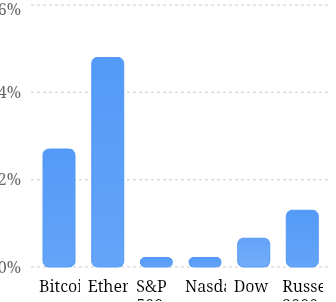
The comparison highlights how much more aggressively cryptocurrencies were sold compared with diversified stock indexes.
But Wednesday wasn’t necessarily evidence of a collapsing stock market. Major indexes were retreating from record territory, and investors were reassessing valuations against a more challenging interest-rate environment.
6. Treasury yields and oil: The real troublemakers
Two of Wednesday’s most influential market forces came from outside the stock and cryptocurrency markets.
Treasury yields: The benchmark 10-year Treasury yield briefly approached 5.37%, its highest level since 2002, before retreating toward 5.29% later in the session.
Oil prices: Brent crude traded around $100–$102 per barrel as geopolitical tensions continued to create supply uncertainty.
Higher yields can make bonds more attractive relative to speculative investments while increasing borrowing costs for businesses and consumers.
Higher oil prices introduce another challenge: inflation.
When energy becomes more expensive, transportation, manufacturing, and consumer costs can increase. Persistent inflation may encourage the Federal Reserve to maintain restrictive monetary policy.
That’s a difficult combination for growth stocks, small businesses, housing, and cryptocurrencies.
7. The Federal Reserve adds another layer of uncertainty
Minutes from the Federal Reserve’s September meeting indicated that policymakers anticipated the possibility of another interest-rate increase before year-end.
However, market expectations suggested that an October increase was far from certain, with traders pricing approximately a 17% probability of a hike at the upcoming meeting.
That distinction matters.
The market isn’t simply reacting to what interest rates are today. Investors are constantly repricing assets based on where they believe borrowing costs, inflation, and economic growth are heading.
For investors, the next major clues will come from inflation data, Treasury yields, Federal Reserve commentary, and corporate earnings.
8. Crypto stocks take a beating
Bitcoin’s decline extended beyond digital exchanges and into publicly traded companies tied to cryptocurrency activity.
Strategy, formerly MicroStrategy, experienced a sharp sell-off as investors reassessed its Bitcoin exposure. Coinbase also declined as broader cryptocurrency weakness weighed on the exchange sector.
Other crypto-related companies, including Robinhood, MARA Holdings, and Circle, also faced selling pressure.
The relationship is important: Owning cryptocurrency-related stocks doesn’t necessarily provide diversification away from cryptocurrency risk.
In some market environments, these stocks can amplify the volatility of the underlying assets.
9. BuckBully’s market outlook: Opportunity or warning sign?
At BuckBully, we believe market declines deserve analysis rather than emotional reactions.
Wednesday’s sell-off creates three possible paths heading into Thursday and the remainder of October.
Bullish scenario: Buyers return
Treasury yields stabilize, oil pressures ease, and Bitcoin reclaims $85,000. Investors begin rebuilding positions in cryptocurrencies and growth stocks.
Neutral scenario: Markets consolidate
Bitcoin trades sideways, stock indexes fluctuate near recent highs, and investors await clearer economic signals before committing additional capital.
Bearish scenario: Selling intensifies
Rising yields and continued inflation concerns encourage further liquidation. Bitcoin tests $80,000 while technology and small-cap stocks face additional pressure.
These scenarios are conditional possibilities, not probability-weighted forecasts.
10. BuckBully’s investor watchlist
| Investment | What we’re watching |
|---|---|
| Bitcoin (BTC) | $83K stabilization and $85K recovery |
| Ethereum (ETH) | Relative strength against Bitcoin |
| Coinbase (COIN) | Trading activity and crypto sentiment |
| Strategy (MSTR) | Bitcoin exposure and stock volatility |
| S&P 500 / SPY | Ability to maintain recent gains |
| Nasdaq / QQQ | AI and technology sector resilience |
| Russell 2000 / IWM | Small-cap sensitivity to borrowing costs |
| Gold | Response to dollar and Treasury yield movements |
For investors contributing regularly, dollar-cost averaging may provide a more disciplined approach than trying to identify the exact bottom. Keeping some cash available also provides flexibility if volatility continues.
However, buying every decline without considering valuation, liquidity, and portfolio concentration can introduce unnecessary risk.
Final word: The bull market faces another test
Wednesday’s market action demonstrated how interconnected today’s financial markets have become.
Bitcoin didn’t fall in isolation. Ethereum, cryptocurrency-related stocks, small-cap equities, and major Wall Street indexes all encountered pressure as investors confronted higher borrowing costs, energy uncertainty, and shifting monetary-policy expectations.
Yet a difficult trading session doesn’t automatically erase a longer-term investment thesis.
The real question is whether Wednesday’s weakness represents a temporary shakeout in an otherwise resilient market or the beginning of a more sustained correction.
BuckBully’s bottom line: Watch the bond market as closely as the stock market. Monitor liquidity before chasing crypto rebounds. And remember that protecting capital is just as important as finding the next opportunity.
Wednesday’s Market Declines
Percentage loss on October 7, 2026. Crypto values are approximate.
| asset | loss |
|---|---|
| Bitcoin | 2.7 |
| Ethereum | 4.8 |
| S&P 500 | 0.22 |
| Nasdaq | 0.22 |
| Dow | 0.66 |
| Russell 2000 | 1.3 |
Be Bullish On What You Hold — but be disciplined about what you buy.
BuckBully.com | Market News & Investment Trends Sources: Reuters, Associated Press, Barron’s, CoinDesk, Yahoo Finance, and Investopedia, October 7, 2026. Market data is subject to change. This article is for informational purposes only and does not constitute personalized investment advice.