
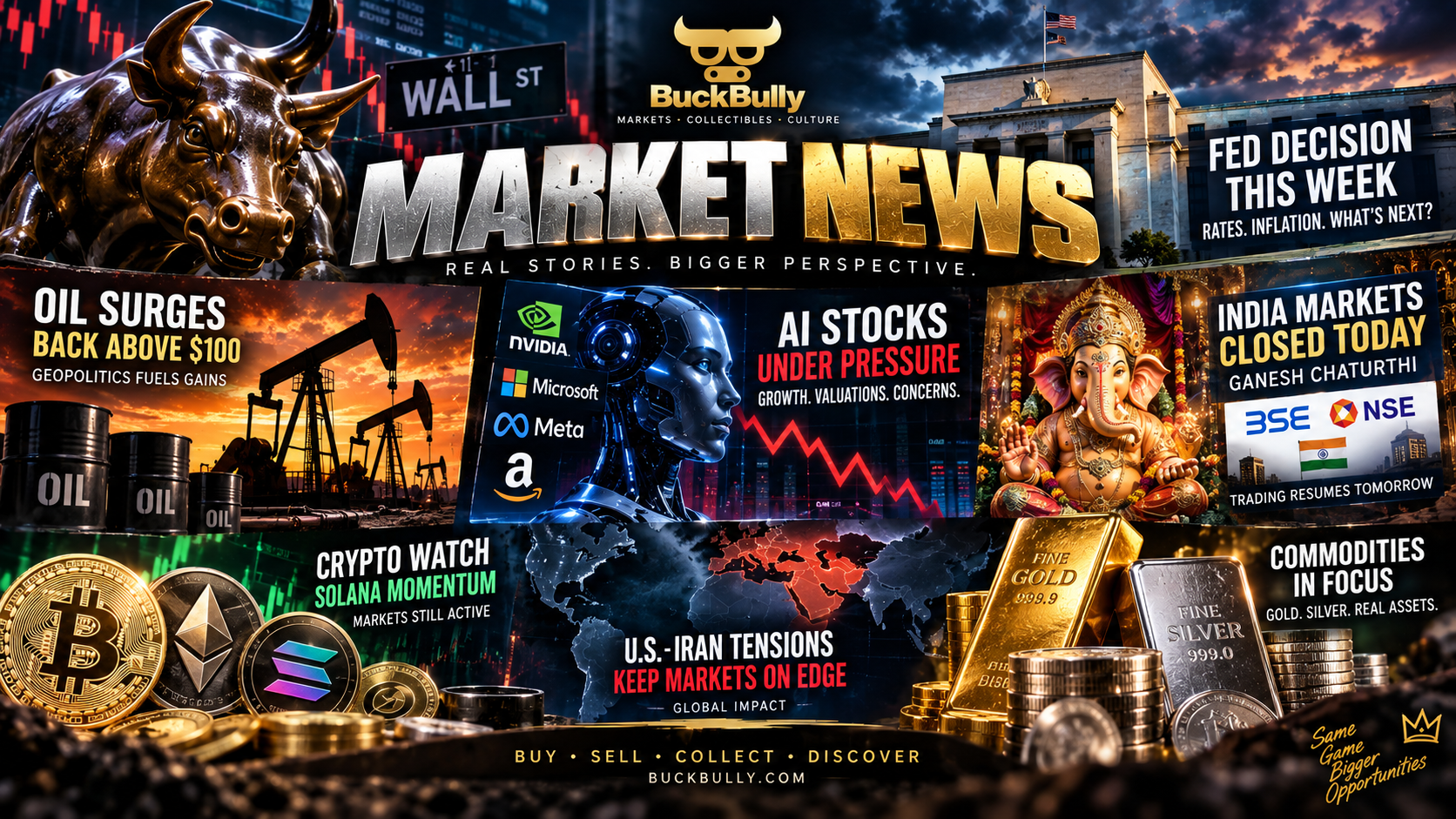
Oil Surges, AI Stocks Wobble & the Fed Takes Center Stage 🐂📉
Wall Street is heading into a new week with plenty to digest.
U.S. stock futures are pointing lower. Oil is surging again. Treasury yields are flirting with 5%. AI stocks are suddenly confronting a new kind of risk. The Federal Reserve has a major decision coming Wednesday.
Meanwhile, one of the world’s largest stock markets isn’t trading at all Monday: India’s BSE and NSE are closed for Ganesh Chaturthi. (Reuters)
This doesn’t look like an ordinary Monday.
It looks like another week where oil, interest rates and technology could fight for control of the market.
🛢️ OIL IS BACK ABOVE $100 — AGAIN
The biggest immediate problem is energy.
Brent crude jumped roughly 3% to $107.81 per barrel, while U.S. crude climbed about 2.9% to $102.94 early Monday. (Reuters)
Middle East shipping risk continues to grow. Threats surrounding the Bab el-Mandeb shipping route are adding another potential choke point to a market already dealing with disruptions around the Strait of Hormuz. Saudi Arabia’s East-West oil pipeline has also been hit by drone attacks. (Reuters)
And there’s a hidden cost that deserves more attention:
Shipping.
Rerouting tankers can add enormous time and expense. Reuters reports that taking alternative routes around Africa can add roughly 22 days to a trip, while tanker rates have reached record levels. (Reuters)
That’s not merely an oil-price story.
It’s potentially another inflation story.
📈 WHY $100 OIL MATTERS TO EVERYBODY
You don’t need to own an oil stock to care about crude.
Higher oil can eventually mean:
Higher gasoline → higher transportation costs → higher manufacturing costs → higher shipping costs → higher consumer prices.
And commodities beyond energy are already moving.
Wheat, soybeans and corn have posted major gains this year, while the broader Bloomberg Commodity Index has reached a decade high amid strength in energy, agriculture and metals. (MarketWatch)
That’s exactly what the Federal Reserve doesn’t want to see.
The inflation battle isn’t just about housing and wages anymore.
Real assets are becoming part of the story again.
🏦 THE FED’S BIG WEEK
Wednesday could be the week’s defining moment.
Markets are now pricing approximately an 86% probability of a 25-basis-point Fed hike, which would be the first increase since 2023. (Reuters)
That’s a dramatic change from the rate-cut expectations investors were discussing earlier.
Why the reversal?
Persistent inflation.
Oil above $100.
And the concern that allowing inflation expectations to climb again could be more damaging than another rate increase.
The 10-year Treasury yield is already sitting just under 5%. (Reuters)
That creates a fascinating setup.
If the Fed hikes, investors immediately start asking:
Is this one and done—or the beginning of another tightening cycle?
Reuters notes futures markets are already pricing roughly 90 basis points of tightening by the second half of 2027. (Reuters)
That’s the number I’d pay attention to.
The Fed decision matters.
What Jerome Powell’s successor Kevin Warsh signals comes next matters even more.
🤖 AI JUST FOUND A NEW RISK
AI has been one of the biggest forces driving global stock markets.
Now the industry’s extraordinary growth is producing a new question:
What happens if governments or the companies themselves decide AI development needs to slow down?
AI-related stocks fell across Asia Monday after leading technology figures called for greater coordination around AI development and safety.
SoftBank fell as much as 13%. South Korea’s Kospi dropped roughly 2.4%, Japan’s Nikkei fell about 1.1%, SK Hynix declined 4.3%, Samsung Electronics lost 2.5%, and TSMC slipped. Nasdaq 100 futures were pointing about 1.2% lower. (Financial Times)
That’s important because AI has become more than a technology story.
It has become a market valuation story.
Billions of dollars have flowed toward chips, data centers, electricity infrastructure, software and AI-related companies.
Anything threatening that growth trajectory could force investors to reconsider how much they’re willing to pay.
⚠️ THIS DOESN’T MEAN THE AI BOOM IS OVER
There’s an important distinction.
Concern over AI safety isn’t the same thing as:
AI demand disappearing.
Companies are still spending enormous amounts on AI infrastructure.
Businesses still want automation.
Data-center construction hasn’t suddenly stopped.
Chip demand hasn’t disappeared overnight.
But markets price expectations.
If investors were assuming virtually unlimited AI expansion and now begin pricing more regulation, slower deployment or higher compliance costs, valuations can fall even while the underlying industry continues growing.
That’s why this week’s AI selloff deserves attention.
The technology doesn’t need to fail for the stocks to correct.
👀 THE 2018 COMPARISON
Jim Cramer is also drawing comparisons between today’s market and 2018.
Back then, investors dealt with rising interest rates, trade tensions and a late-year market selloff.
Cramer’s message isn’t necessarily to panic. His argument is closer to trimming oversized winners rather than dumping everything because history might repeat itself. (BeInCrypto)
There are definitely similarities.
Rising rates.
Expensive technology stocks.
Geopolitical uncertainty.
Questions about market concentration.
But 2026 isn’t 2018.
History rarely repeats perfectly.
The useful part of the comparison isn’t predicting another identical crash.
It’s remembering what can happen when valuations are high while liquidity becomes tighter.
That’s when markets become less forgiving.
🇮🇳 INDIA TAKES A DAY OFF
While U.S. futures trade and Asian markets react to AI concerns, India’s two major exchanges are closed Monday.
Both the Bombay Stock Exchange (BSE) and National Stock Exchange (NSE) are closed September 14 for Ganesh Chaturthi.
There is no trading or settlement in stocks, derivatives or securities lending and borrowing. Regular trading resumes Tuesday, September 15. (Business Standard)
It’s simply a scheduled holiday—not a response to market conditions.
But it means Indian investors will return Tuesday needing to digest whatever happens globally Monday.
₿ CRYPTO ISN’T SITTING THIS OUT
Crypto remains another piece of the risk puzzle.
Solana recently bounced back above the psychologically important $100 level after briefly trading below it. (TradingView)
That’s encouraging for SOL bulls, but I’d be careful with some of the headlines circulating around crypto right now.
Stories combining legitimate market commentary with promotions for obscure token presales deserve extra scrutiny.
For BuckBully, the useful signal isn’t whether some new presale claims it’s “almost sold out.”
It’s whether established networks are showing:
real users, real transactions, real liquidity and real institutional adoption.
That’s a much better way to separate market development from marketing.
🐂 THE BULL CASE
There’s still a path for stocks to surprise people.
Friday demonstrated that investors remain willing to buy weakness.
If oil retreats again, the Fed delivers a well-telegraphed quarter-point hike, Treasury yields remain below 5%, and AI fears prove temporary, the current selloff could become another dip-buying opportunity.
There’s also an interesting contrarian possibility.
The more fear gets priced into markets before Wednesday’s Fed announcement, the lower the bar becomes for a relief rally.
Markets don’t require perfect news.
Sometimes they simply need news that isn’t as bad as feared.
🐻 THE BEAR CASE
The downside scenario is easier to see.
Imagine this combination:
Oil stays above $100.
10-year Treasury breaks 5%.
Fed signals multiple additional hikes.
AI stocks continue correcting.
That’s a difficult environment for expensive growth stocks.
Higher yields make bonds more competitive with stocks while simultaneously increasing corporate borrowing costs and reducing the present value investors assign to future earnings.
Add an energy shock and suddenly the market has to worry about something Wall Street hates:
slower growth + persistent inflation.
That’s why this week matters.
🐂 BUCKBULLY MARKET WATCH
I’m narrowing the week down to five things:
OIL — $100: Can crude stay above it?
10-YEAR — 5%: Probably the most important line in the bond market.
FED — WEDNESDAY: A quarter-point move is increasingly expected; the outlook afterward is the bigger story.
AI STOCKS: Does Monday’s weakness spread to U.S. mega-cap technology?
COMMODITIES: Oil isn’t alone. Watch whether the broader real-assets rally continues. (Reuters)
THE BUCKBULLY TAKE 🐂
The market is starting to connect several stories that previously looked separate.
War pushes oil higher.
Oil makes inflation harder to kill.
Inflation pushes interest rates higher.
Higher rates pressure expensive stocks.
AI uncertainty hits one of the market’s strongest sectors.
And suddenly investors who spent years chasing growth start looking again at cash, bonds, commodities, gold and other real assets.
That’s why I’m not treating Monday’s futures decline as just another red morning.
The important question is whether we’re seeing another temporary shakeout—or the beginning of a genuine rotation in what the market values.
The answer may depend on three numbers:
$100 oil.
5% Treasury yields.
The Fed’s next rate.
If all three keep moving higher together, Wall Street has a problem.
If oil cools and the Fed restores confidence, bulls could regain control quickly.
This week isn’t about predicting every candle. It’s about watching where money moves when investors are forced to choose between growth, yield and protection.
Buy • Sell • Collect • Discover.
Be Bullish On What You Value. 🐂
BuckBully content is for informational and entertainment purposes only and isn’t financial or investment advice.