
Why This Partnership Could Be Bigger Than an Endorsement
LeBron James has spent his career building a brand that extends far beyond basketball. Now, his latest partnership puts him at the center of another rapidly growing market: prediction trading.
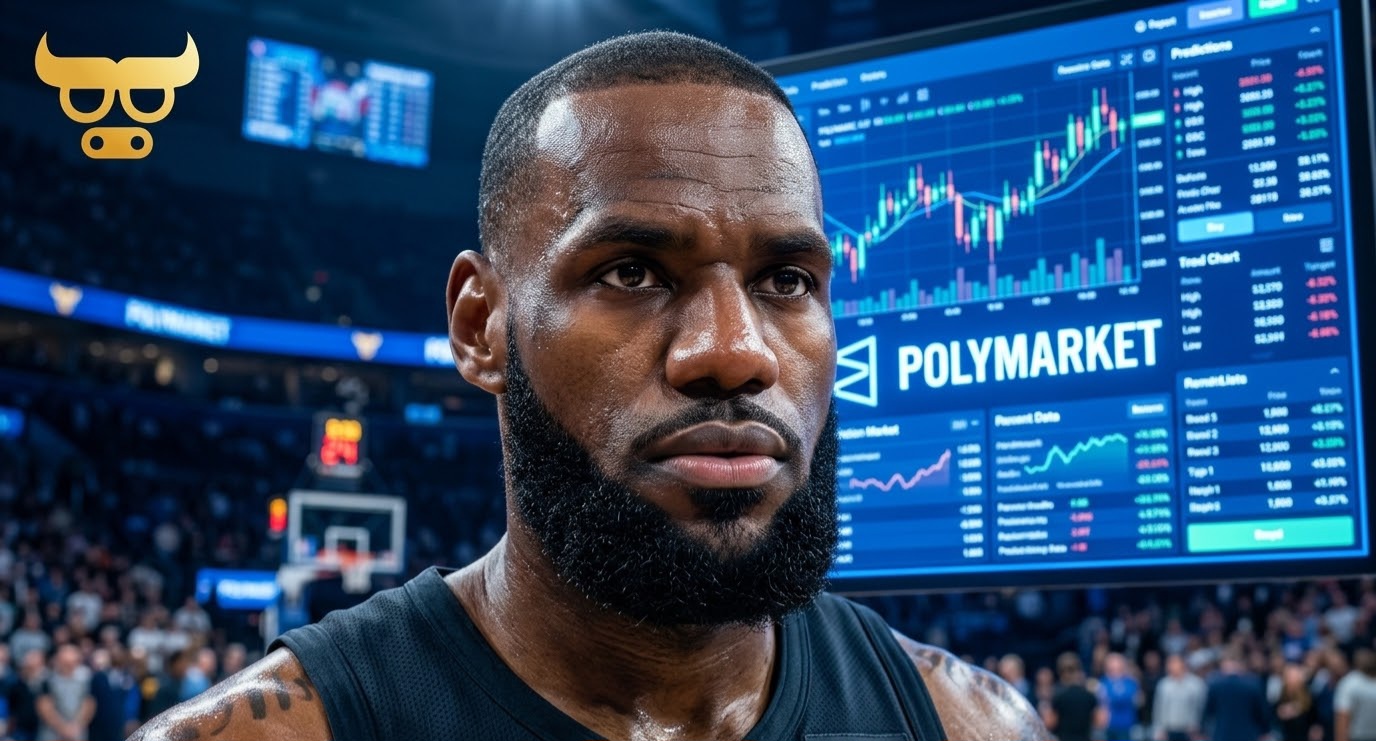
James has partnered with Polymarket, a prediction-market platform where users trade contracts based on whether real-world events will happen. His campaign is focused on football and comes after his previous DraftKings endorsement ended. The broader advertising campaign also features sports and entertainment figures such as Derek Jeter, Eli Manning, Sue Bird and Spike Lee. (The Block)
At first glance, it’s another celebrity endorsement.
But we’ve seen a similar playbook before.
And it ended with FTX.
From FTX to Polymarket
A few years ago, cryptocurrency exchange FTX seemed to be everywhere.
Tom Brady promoted it. Stephen Curry appeared in its advertising. Shohei Ohtani, Naomi Osaka and other major personalities became associated with the brand. FTX even put its name on the Miami Heat’s arena.
The message was powerful without ever having to say it directly:
If people this successful trust this new financial world, maybe you should too.
Then FTX collapsed in November 2022.
Founder Sam Bankman-Fried was ultimately convicted of fraud and sentenced to 25 years in prison. Customers lost access to billions of dollars while the bankruptcy and recovery process unfolded.
Celebrity endorsers were subsequently sued by investors. Most claims against figures including Brady and Curry were dismissed in 2025 because plaintiffs hadn’t sufficiently shown that the celebrities knew about FTX’s fraud. However, some state securities claims were allowed to continue. (Reuters)
That’s an important distinction.
The athletes weren’t found to be masterminds behind FTX.
Their involvement illustrates a different problem: celebrity endorsements can provide instant credibility to complicated financial products that many consumers don’t fully understand.
And FTX wasn’t the only warning.
The SEC charged Kim Kardashian over her promotion of EthereumMax after finding she hadn’t properly disclosed the $250,000 she received to promote the crypto asset security. She agreed to pay $1.26 million to settle the charges. (SEC)
Former NBA star Paul Pierce faced similar SEC charges involving EthereumMax. The SEC alleged that Pierce failed to disclose more than $244,000 in compensation and made misleading promotional statements. He agreed to pay approximately $1.4 million in penalties, disgorgement and interest. (SEC)
The lesson wasn’t that every celebrity-backed financial product is fraudulent.
It was simpler:
Fame is not financial due diligence.
So Is LeBron’s Polymarket Partnership the Same Thing?
No.
There is currently no evidence that LeBron James is promoting a fraudulent company, and comparing Polymarket directly to FTX would go too far.
But there is a legitimate historical comparison in how a new financial category becomes normalized.
Crypto was once something most Americans barely understood.
Then came:
Bitcoin → crypto exchanges → celebrity endorsements → sports sponsorships → mainstream adoption → regulatory battles.
Prediction markets appear to be following a remarkably familiar path:
Prediction markets → rapid growth → sports integration → celebrity endorsements → mainstream adoption → regulatory battles.
LeBron’s involvement matters because he isn’t merely another influencer.
He’s one of the world’s most recognizable athletes.
His initial Polymarket announcement reportedly accumulated nearly 10 million views within seven hours. (Yahoo Sports)
That’s the power Polymarket is purchasing.
Not LeBron’s ability to predict football games.
His ability to make prediction markets feel normal.
What Are We Actually Being Sold?
This is where consumers should understand the distinction between the celebrity and the product.
Prediction markets allow people to trade contracts around questions such as:
Will a team win?
Will Bitcoin hit a certain price?
Will interest rates fall?
Who will win an election?
Will a particular event happen before a certain date?
The market price essentially represents what traders collectively believe the probability of that event is.
That makes prediction markets fascinating because they’re simultaneously financial markets, forecasting tools and—for many users—a form of wagering on outcomes.
Sports could be the perfect entry point.
Someone who would never trade a contract about Federal Reserve policy might happily predict Sunday’s football game.
Once they’re comfortable with the platform, however, there are thousands of other events to trade.
That’s where LeBron’s partnership becomes much bigger than football.
The Next Evolution of Sports Fans
Sports fandom has already transformed dramatically.
We went from simply watching games to:
Sports → Fantasy Sports → Sportsbooks → Prediction Markets
And the next generation of fans may participate in all four simultaneously.
Imagine watching an NBA game while probabilities move in real time.
Your team goes down 15 points.
Its championship probability falls.
A player gets injured.
Another market moves.
A trade rumor appears.
Contracts involving that player’s future suddenly change.
Prediction markets effectively turn information into a tradable asset.
And that’s where things become both fascinating and potentially dangerous.
The Insider Problem
Consider a hypothetical Polymarket contract:
“Will LeBron James retire before next season?”
Millions of fans might speculate.
But LeBron actually knows what he’s thinking.
His wife might know.
His agent might know.
His teammates or Lakers executives might know.
Now imagine someone close to that information trading before everyone else learns the answer.
Prediction markets therefore raise difficult questions about insider information, market manipulation and conflicts of interest—particularly when athletes, leagues or celebrities themselves have relationships with companies operating these markets. Recent coverage of Polymarket’s sports push has highlighted those regulatory and ethical concerns. (CT Insider)
That’s an area regulators will likely continue watching closely.
The FTX Lesson Shouldn’t Be Forgotten
FTX provides a valuable historical warning without requiring us to claim Polymarket is the next FTX.
Before its collapse, FTX had professional athletes, celebrities, enormous sponsorships and mainstream credibility.
None of those things told consumers what was actually happening behind the company’s balance sheet.
Likewise, LeBron’s presence tells us virtually nothing about whether an individual prediction is a smart trade.
That’s the distinction consumers should remember:
An endorsement tells you who’s getting attention.
It doesn’t tell you what’s a good investment or trade.
The SEC made essentially this same point following its celebrity crypto enforcement cases: investors shouldn’t determine whether an investment is appropriate simply because a celebrity promotes it. (SEC)
🐂 BuckBully Future Insight: Prediction Markets Could Become Much Bigger
There’s another possibility worth considering.
Maybe prediction markets don’t primarily become the next sportsbooks.
Maybe they become something closer to a real-time information exchange.
Instead of reading:
“Analysts believe there’s a strong possibility of recession.”
You could see:
RECESSION BEFORE 2028 — 31%
Instead of:
“Experts believe Bitcoin could reach $200,000.”
You could see traders putting actual money behind the probability.
Politics.
Economics.
Crypto.
Sports.
Technology.
Entertainment.
Weather.
Corporate events.
Prediction markets could eventually create continuously changing prices for thousands of uncertain future events.
If that happens, the probability itself becomes information—even for someone who never places a trade.
That’s potentially enormous.
But Here’s the Question Nobody Can Answer Yet
Will prediction markets mature into legitimate mainstream information markets?
Or will aggressive speculation, insider information, questionable contracts and regulatory problems eventually cause their own FTX-style reckoning?
We don’t know.
And that’s precisely why the LeBron partnership matters.
LeBron isn’t proof that Polymarket is safe.
He’s evidence that prediction markets are becoming mainstream.
There is a major difference.
FTX taught consumers an expensive lesson about confusing celebrity credibility with financial credibility.
Prediction markets now have an opportunity to prove they learned something from crypto’s mistakes.
Because history doesn’t always repeat itself.
But Wall Street, crypto and sports have shown us that when money, hype and celebrity influence collide, history has a habit of rhyming.
BuckBully Bottom Line 🐂
LeBron partnering with Polymarket could eventually be remembered as one of those moments when prediction markets crossed from an internet niche into mainstream American culture.
That doesn’t make Polymarket another FTX.
But FTX should permanently change the question consumers ask when they see a superstar promoting the next big financial trend.
Don’t ask:
“LeBron’s involved—should I get involved too?”
Ask:
“How does this actually work, who’s regulating it, what are the risks, and who makes money if I participate?”
That’s the difference between following a celebrity and understanding the market.
What will this be worth—and what happens next?
BuckBully Market Insight: Prediction markets should be viewed as speculative markets, not guaranteed forecasts or investments. Market probabilities can change quickly and can be wrong