
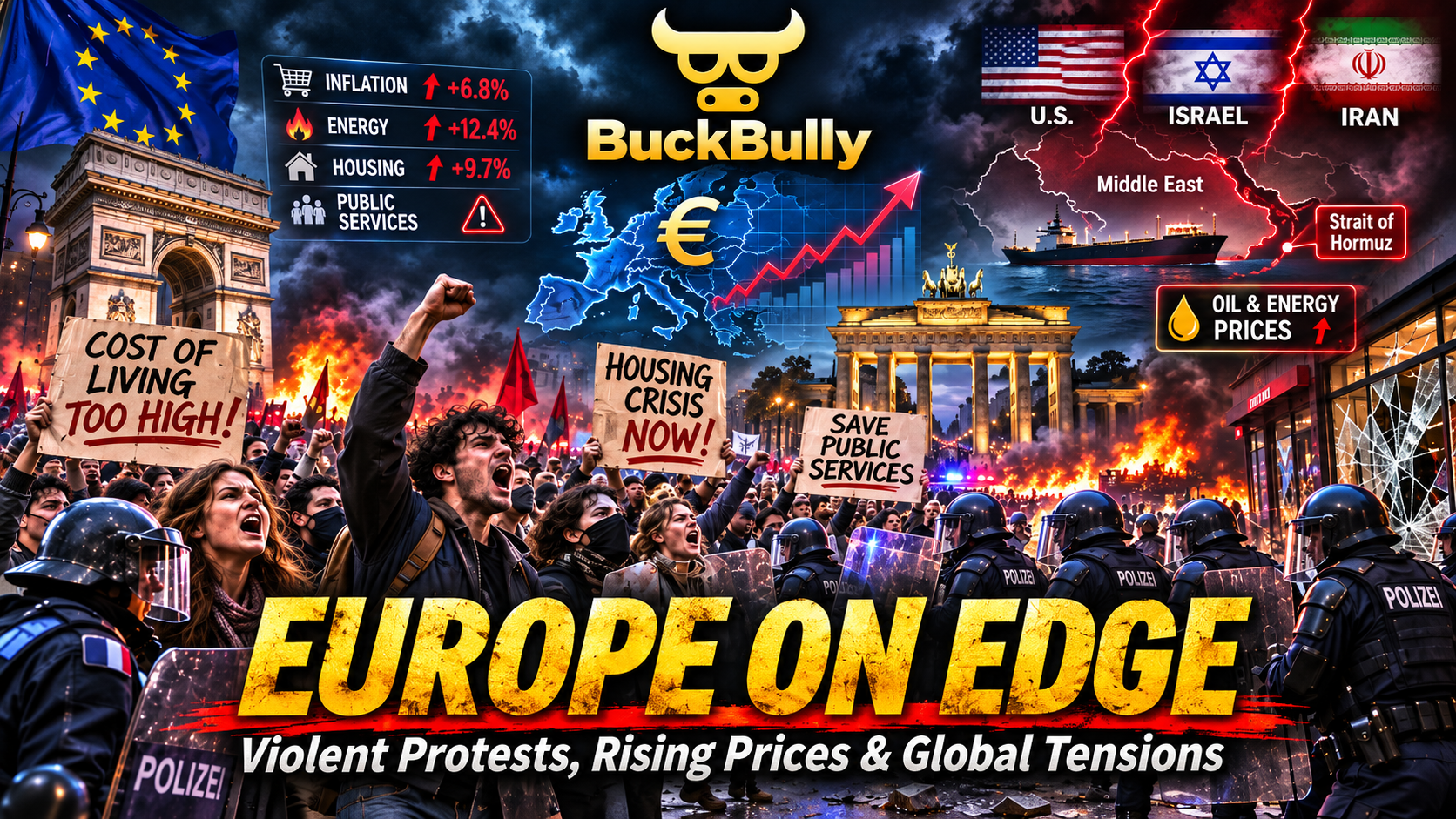
EUROPE ERUPTS: THE GLOBAL COST-OF-LIVING REVOLT
From Paris to Frankfurt, rising expenses, housing insecurity and public frustration are bringing demonstrators into the streets. Could geopolitical conflict make the economic pressure even worse?
November 1, 2026 World News Economic Analysis Civil Unrest01 | Europe at a Breaking Point
Across Europe, households are questioning whether wages, education systems and essential public services can keep pace with the cost of daily life.
France has seen three consecutive weekends of large-scale demonstrations. Germany’s youth-led protests have added concerns over potential military conscription to demands for affordable housing and better-funded schools.
Most demonstrators have marched peacefully. Nevertheless, masked groups and other individuals have clashed with police in several cities. These incidents have intensified the political debate over public safety and the right to protest.
02 | Interactive Global Civil Unrest Timeline
Explore selected economic and youth-led protest movements. These events have distinct causes and are not one coordinated global uprising.
03 | Country-by-Country Protest Monitor
Select a country for its reported developments and principal grievances.
04 | How Large Are France’s Demonstrations?
Official estimates for three successive October protest weekends.
05 | How the U.S.–Israel–Iran Conflict Hits Europe
The conflict involving the United States, Israel and Iran has disrupted energy markets and created additional uncertainty around oil and shipping.
Strikes and counterstrikes increase uncertainty for commercial shipping and energy producers.
Restricted transit can reduce accessible oil and liquefied-natural-gas supply.
Global commodity prices and transportation insurance can increase.
Fuel, heating, freight, food production and distribution may become more expensive.
Households can demand relief, while governments face difficult decisions about budgets, defense, subsidies and public services.
The geopolitical connection
Europe does not need to be a direct battlefield to experience economic consequences. The global energy market transmits supply disruptions across borders.
Some European protesters also oppose military spending or potential conscription. However, local issues such as housing and school funding remain significant independent causes of unrest.
06 | Interactive Household Energy Shock Calculator
What happens to a household’s monthly expenses when energy-linked costs increase?
Illustrative scenario only. The slider is not a forecast of oil prices or a measurement of actual European inflation.
15% scenario increase
Calculations use illustrative euro budgets for electricity, heating, transportation and an energy-sensitive share of other expenses. They do not imply all food prices will rise by the slider percentage.
07 | Why Young People Are Leading the Protests
Housing
High rents and limited affordable homes can delay independent living.
Wages
Pay increases may not restore purchasing power lost to earlier price increases.
Education
Underfunded schools and uncertain job prospects weaken confidence in economic opportunity.
Security
War, military service debates and fiscal pressures introduce new concerns about the future.
08 | The World Beyond Europe
Kenya: An Earlier Warning Sign
In June 2024, youth-led protests against proposed tax increases spread across Kenya. Demonstrators argued that additional taxes would worsen already difficult living conditions. Confrontations and reports of excessive police force deepened the crisis.
A Global Pattern, Not a Single Movement
Similar frustrations can emerge under very different political systems. Expensive essentials, limited opportunities, disputed budget priorities and declining confidence in government can all contribute to protests.
But each movement must be evaluated separately. Inflation does not explain every uprising, and neither peaceful demonstrations nor violent incidents should be assumed to have identical motivations.
09 | Global Stability Watch
Select an indicator to understand what BuckBully will be watching as economic and geopolitical developments unfold.
10 | BuckBully Outlook: What Happens Next?
The next phase may depend less on the size of any one march and more on how governments respond to the economic grievances behind them.
Stabilization scenario: Energy costs moderate, wages catch up, governments negotiate reforms and demonstrations remain predominantly peaceful.
Continued pressure scenario: Housing and living expenses remain elevated, protests continue and political polarization deepens.
Escalation scenario: Renewed disruptions to energy shipping, sharper public spending conflicts or serious confrontations create additional social and economic strain.
None of these scenarios is inevitable. Protest movements, governments and economic conditions can change quickly.
Our Final Take
Europe’s unrest reveals a deeper struggle over affordability, opportunity and trust. When a generation believes that working, studying and following the rules no longer guarantees a secure future, political pressure grows.
The Iran conflict can amplify that pressure through energy and trade costs. But the problems predate the latest escalation, and the countries involved face different domestic challenges.
For BuckBully, the issue to watch is not simply whether protests spread. It is whether economic relief and political reform can restore public confidence before repeated confrontations make the situation worse.
Reporting & Research
These references underpin the historical events and geopolitical background. Interactive projections are illustrative.