
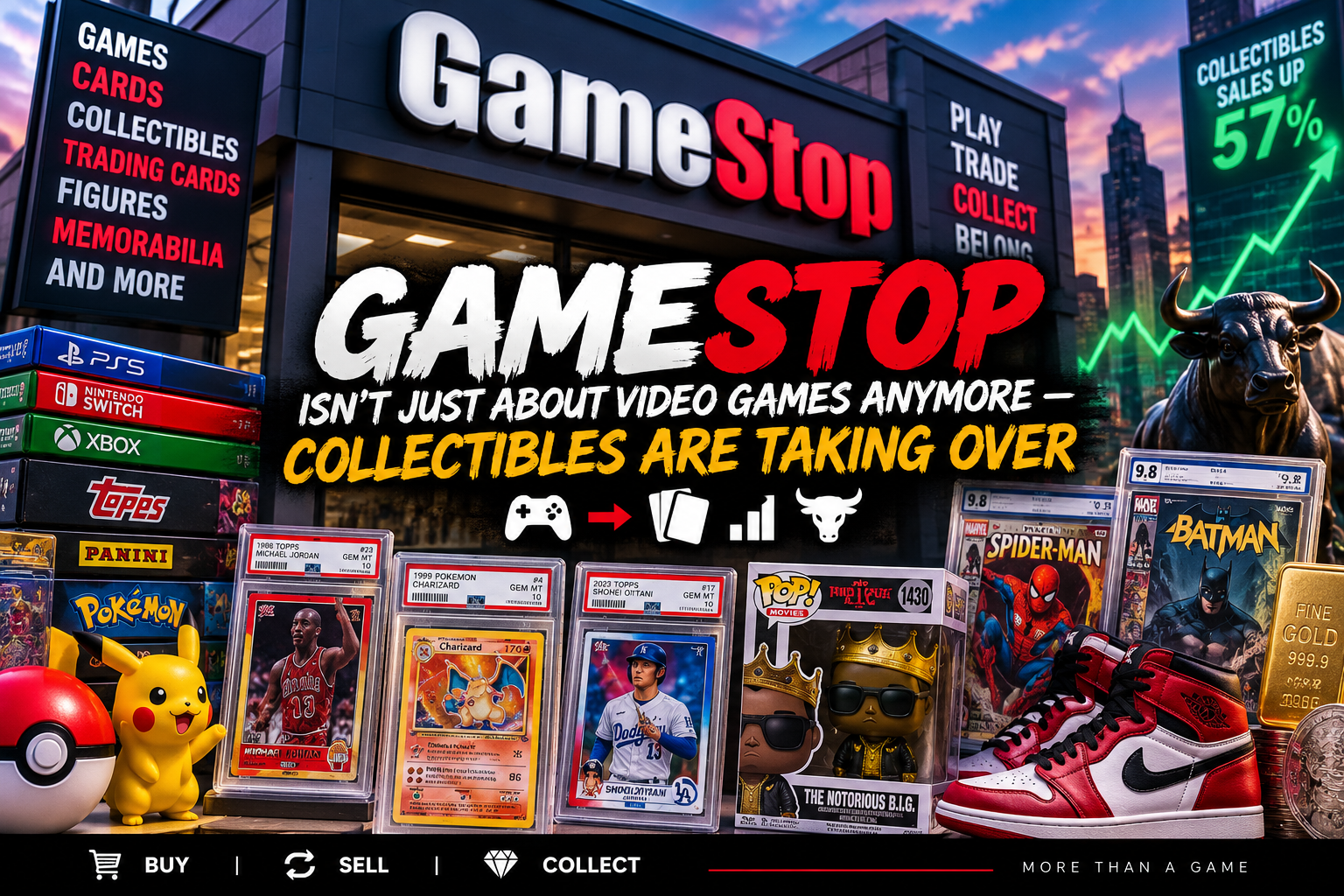
Collectibles Are Taking Over 🎮➡️🃏🐂
For years, the name GameStop immediately meant one thing: video games.
Walk into a store, trade in an old game, pick up the newest release, maybe grab a controller on the way out.
But GameStop’s latest earnings reveal something much bigger happening beneath the surface.
Collectibles have officially become GameStop’s largest business.
And for collectors, sellers and businesses like BuckBully, that’s worth paying attention to.
THE NUMBER THAT CHANGES THE STORY: 57% 📈
GameStop reported $356.3 million in collectible sales during its fiscal second quarter, a whopping 57% increase from $227.6 million a year earlier.
Collectibles now account for 45.1% of GameStop’s total sales.
Video games?
Just 33.3%.
Pre-owned and refurbished products accounted for the remaining 21.6%.
Think about that for a second.
A company with “Game” in its name now generates considerably more revenue from collectibles than video games.
That’s not a side hustle anymore.
That’s a transformation.
WHAT DOES GAMESTOP CONSIDER A “COLLECTIBLE”?
This is bigger than Pokémon cards sitting beside the cash register.
GameStop’s official filing says its collectibles category includes new and pre-owned trading cards, action figures, statues, replicas, apparel, plush products, toys, building sets, home goods and other products aimed at gaming, entertainment and pop-culture collectors.
It even includes fees earned from helping customers submit trading cards to third-party grading services.
That’s significant because it closely resembles the broader collecting ecosystem:
Buy → Collect → Grade → Trade → Sell → Repeat.
Sound familiar?
That’s increasingly how collectibles function as their own marketplace.
THE TRADING-CARD BOOM IS GETTING SERIOUS 🃏
Trading cards are no longer something major retailers can treat as a tiny hobby section.
Sports cards, Pokémon, graded cards and other collectible categories have developed sophisticated secondary markets where buyers can track sales history, condition, scarcity and population counts.
GameStop clearly sees an opportunity.
In fact, its SEC filing specifically says consumer engagement has shifted toward collectibles and trading cards, which are now the company’s largest product category.
That’s probably the biggest sentence in this entire story.
This isn’t analysts guessing where GameStop is headed.
GameStop itself is acknowledging the shift.
FROM MEME STOCK TO COLLECTIBLES COMPANY?
Remember 2021?
GameStop became the face of the meme-stock era.
Retail traders battled hedge funds, Reddit exploded, GME shares went crazy and GameStop became a cultural phenomenon far beyond gaming.
Five years later, the company is trying to build an actual business capable of surviving the decline of physical videogame retail.
And collectibles may be one of the answers.
Overall second-quarter revenue actually fell to $790.2 million from $972.2 million a year earlier.
So this wasn’t a quarter where everything was booming.
Video-game sales fell substantially.
Yet GameStop produced record second-quarter operating income of $160.2 million, compared with $66.4 million a year earlier, while net income reached $298.7 million. The company also raised its fiscal-2026 adjusted EBITDA outlook to more than $650 million.
That makes the collectibles growth stand out even more.
THE $100 BILLION BET 💰
Barron’s points to estimates suggesting the U.S. collectibles market could exceed $100 billion by 2033.
Whether that exact projection ultimately proves accurate isn’t the most important part.
Look around.
Trading cards have professional grading.
Sneakers have authentication.
Coins have grading.
Comics have grading.
Autographs have authentication.
Vintage games are graded.
Collectibles have online price histories.
Auctions happen globally.
Buyers can scan a card on their phone and immediately research recent sales.
The hobby is becoming increasingly financialized.
Collectors still buy things because they love them — but more people also think about scarcity, condition, appreciation and resale value.
That’s where collecting begins overlapping with markets.
And that’s basically the BuckBully philosophy:
Collectibles meet markets.
GAMESTOP + EBAY IS AN INTERESTING COMBINATION 👀
There’s another layer to this story.
GameStop held approximately 43.4 million shares of eBay worth roughly $4.9 billion at the end of the quarter.
That’s particularly interesting because is already one of the world’s most important secondary marketplaces for collectibles.
Earlier this year, GameStop CEO Ryan Cohen even attempted to acquire eBay, although eBay rejected the proposal.
Imagine the ecosystem GameStop appears interested in:
Physical stores + trade-ins + trading cards + grading + online marketplaces + resale.
That’s much bigger than selling PlayStations.
INSIDERS ARE PUTTING MONEY BEHIND THE COMPANY
The earnings weren’t the only development getting attention.
GameStop director Lawrence Cheng purchased 55,000 shares for roughly $1.03 million after the quarterly results.
And today, September 11, CEO Ryan Cohen disclosed an even larger purchase.
Cohen bought 1 million additional GameStop shares for approximately $20.4 million, increasing his direct holdings to about 39.3 million shares.
An insider purchase doesn’t guarantee that a stock will rise.
But when executives and directors put millions of their own dollars into shares, investors understandably pay attention.
WHY ARE COLLECTIBLES WINNING?
I think there are several forces working together.
Nostalgia: Adults finally have money to buy things they couldn’t afford as kids.
Scarcity: Limited cards, autographs, numbered parallels and discontinued products create genuine supply constraints.
Culture: Sports, sneakers, gaming, music and pop culture increasingly overlap.
Technology: Online marketplaces make pricing and selling dramatically easier.
Authentication: Grading services have helped standardize condition and increase buyer confidence.
Social media: TikTok, YouTube and livestream selling have turned collecting into entertainment.
And perhaps most importantly:
Collecting is fun.
Stocks sit inside an app.
A collectible sits in your hand.
There’s an emotional component that traditional financial assets don’t provide.
BUT DON’T CONFUSE “COLLECTIBLE” WITH “INVESTMENT” ⚠️
This part matters.
Just because the collectibles industry is growing doesn’t mean every collectible will increase in value.
Most won’t.
Mass-produced cards can collapse.
Players can lose popularity.
Trends disappear.
Grading populations increase.
Artificial scarcity can fail.
Shipping and marketplace fees eat into profits.
And something being listed on eBay for $1,000 doesn’t mean somebody will actually pay $1,000.
The better question isn’t:
“What are people asking?”
It’s:
“What are people actually buying?”
That’s why completed sales, scarcity, condition, demand and liquidity matter.
WHAT THIS MEANS FOR SMALLER SELLERS 🐂
GameStop’s success doesn’t necessarily hurt independent collectible sellers.
In some ways, it validates them.
When a major public company generates $356 million in collectible sales in one quarter, it’s evidence that the hobby isn’t some tiny niche hiding in the back of a comic shop.
There’s real consumer demand.
But smaller sellers have an advantage GameStop can’t easily replicate:
personality and specialization.
A collector might know vintage currency.
Someone else knows Jordan cards.
Another knows autographs.
Someone knows coins.
Another knows sneakers.
The opportunity isn’t necessarily trying to become another GameStop.
It’s becoming the place people trust for your particular lane.
THE BUCKBULLY TAKE 🐂
GameStop’s transformation is bigger than one good quarter.
Five years ago, the biggest question was whether physical videogame retail could survive.
Now GameStop is quietly answering a different question:
What if the future isn’t really about games?
Collectibles produced 23.4% of GameStop’s quarterly revenue one year ago.
Today they’re at 45.1%.
That’s an extraordinary shift.
Trading cards aren’t replacing the stock market.
Pokémon isn’t replacing gold.
A Michael Jordan card isn’t a Treasury bond.
But they all demonstrate something fundamental about value:
People will pay for things that are scarce, desirable, recognizable and difficult to replace.
GameStop seems to understand that.
And apparently, it’s willing to bet its future on it.
The hobby isn’t dying. It’s becoming an industry.
Buy. Sell. Collect. Discover.
Be Bullish On What You Value. 🐂
BuckBully content is for informational and entertainment purposes. Collectible values fluctuate, and past sales or market growth do not guarantee future appreciation.