
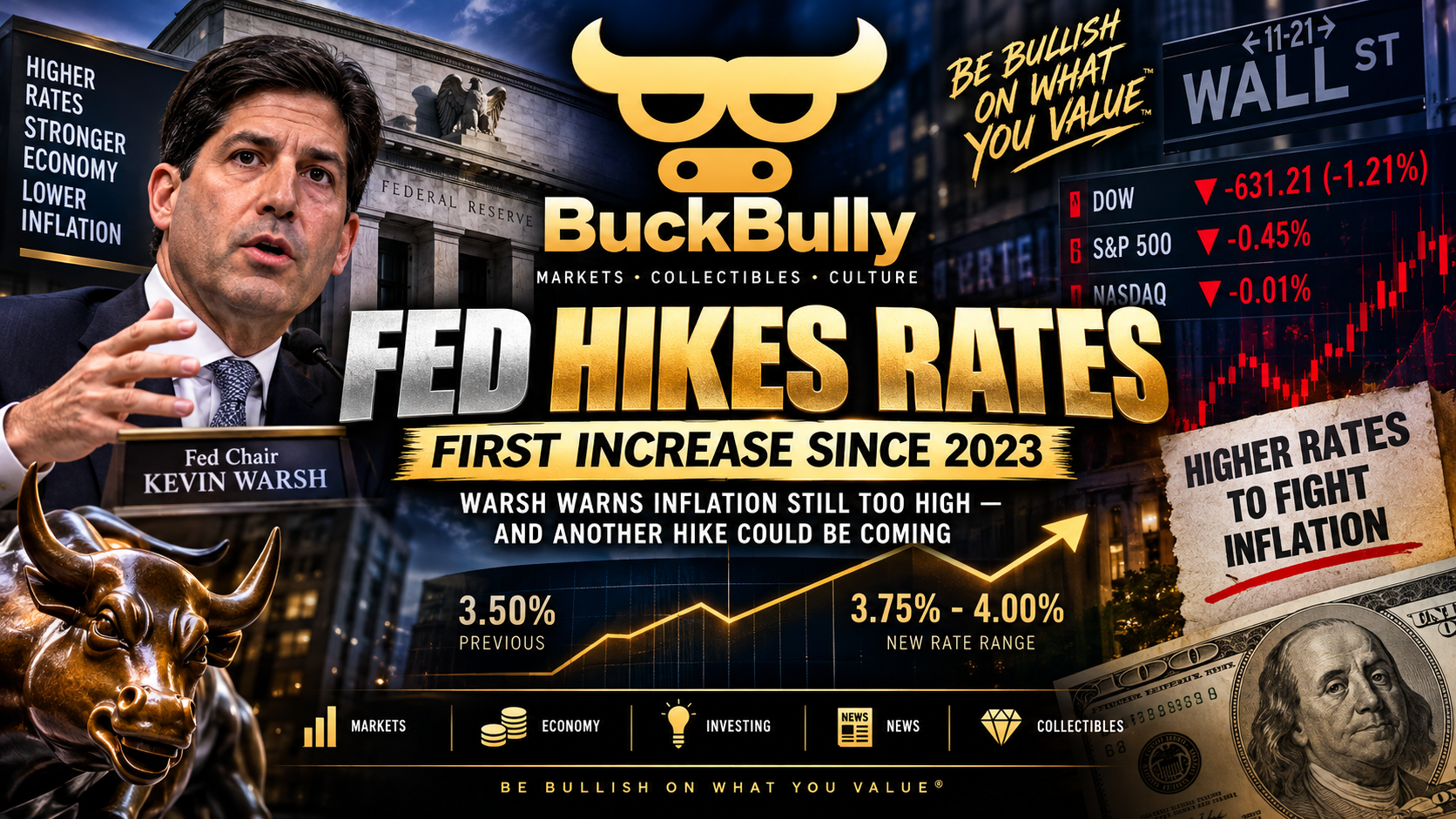
First Rate Hike Since 2023 Sends Dow Down 600+ Points 🐂📉
The Federal Reserve finally made its move.
After months of stubborn inflation, rising energy prices and surging Treasury yields, the Fed unanimously raised its benchmark interest rate by 0.25 percentage point, taking the federal-funds target range to 3.75%–4.00%. It was the central bank’s first rate increase since 2023. (Federal Reserve)
Wall Street knew a hike was probably coming.
What investors didn’t necessarily want to hear was that this might not be the last one.
🏦 Why the Fed Hiked
The Fed’s message was straightforward: the economy remains relatively resilient, but inflation is still running too hot.
The official FOMC statement said economic activity continues to expand at a solid pace, domestic spending has remained resilient, productivity growth is strong and capital investment remains robust. At the same time, the Fed said “inflation remains elevated” and that Wednesday’s hike is intended to bring inflation back toward its 2% target more quickly. (Federal Reserve)
Fed Chair Kevin Warsh was even more direct during his press conference.
“Inflation is too high and has been for too long.”
In other words:
The Fed doesn’t think the inflation fight is finished.
📈 And Another Rate Hike Could Be Coming
This is where Wednesday’s announcement really caught Wall Street’s attention.
The Fed’s new projections showed a median year-end federal-funds rate of approximately 4.1%, implying another quarter-point increase could be appropriate this year. Warsh, however, declined to commit to a specific future decision. (CNN Transcripts)
According to the projections reported by the Wall Street Journal, 12 of 18 Fed officials anticipated one additional increase by the end of 2026. (The Wall Street Journal)
So Wednesday wasn’t necessarily a one-and-done hike.
The market now has to consider the possibility of:
3.75%–4.00% today → potentially 4.00%–4.25% later this year.
📉 Wall Street Didn’t Like the Message
Stocks had been relatively calm before Warsh’s press conference.
Then the selling accelerated.
The Dow Jones Industrial Average dropped 631.21 points, or 1.21%. The S&P 500 declined roughly 0.45%, while the Nasdaq Composite finished almost flat, down about 0.01%. (The Wall Street Journal)
That divergence is interesting.
This wasn’t simply another giant-tech collapse. Investors were repricing what higher interest rates and elevated borrowing costs could mean across the broader economy.
Bond yields moved sharply as well.
The 2-year Treasury yield reached 4.725%, its highest level since July 2024, while the 10-year Treasury touched 5.003%, around its highest level in 19 years. (The Wall Street Journal)
That’s arguably the bigger number to watch.
💰 Why 5% Treasury Yields Matter
When investors can earn around 5% from a 10-year U.S. Treasury, stocks have more competition.
Higher Treasury yields can also translate into more expensive:
Mortgages • Auto loans • Credit cards • Business financing • Commercial real estate loans
And higher rates make future corporate profits less valuable in today’s dollars, which can put pressure on expensive growth stocks.
This doesn’t automatically mean stocks have to crash.
It means the hurdle for owning riskier assets gets higher.
🏠 Consumers Could Feel This One
The rate hike doesn’t instantly add exactly 0.25% to every consumer loan.
But tighter monetary policy and elevated bond yields can keep borrowing costs high.
Mortgage rates were already above 7% around Wednesday’s decision, while homebuilder confidence had fallen to a one-year low. (The Wall Street Journal)
Meanwhile, consumers haven’t stopped spending.
August retail sales increased 1.2%, beating expectations for roughly 0.9% growth. (Yahoo Finance)
That’s part of the Fed’s dilemma.
The economy hasn’t weakened enough to eliminate inflation pressure.
🛢️ Don’t Forget About Oil
The Fed can raise interest rates.
It can’t produce more crude oil or eliminate geopolitical disruptions.
Oil remained above $100 per barrel around the Fed decision, adding another inflationary complication. (Yahoo Finance)
Higher energy prices can eventually affect transportation, manufacturing, food production and countless other costs.
That means the Fed is fighting inflation partly created by forces monetary policy can’t directly control.
Higher rates can reduce demand.
They can’t pump another barrel of oil.
🤖 AI Investment Is Part of the Story Too
There’s another interesting wrinkle: AI.
Warsh argued that higher long-term bond yields aren’t necessarily evidence that investors have lost confidence in the Fed.
He pointed instead to a strong economy and enormous capital spending—including financing demand from large technology companies building AI infrastructure and data centers—as factors increasing competition for capital. He also cited geopolitical uncertainty as contributing to higher long-term borrowing costs. (Reuters)
That’s a fascinating collision:
AI boom → massive capital spending → greater demand for financing → higher yields
while simultaneously:
Higher yields → tougher valuations for growth stocks.
The AI boom itself may therefore be contributing to some of the financial conditions technology investors now have to navigate.
🐂 The BuckBully Takeaway
September 16 wasn’t important simply because the Fed increased rates by 25 basis points.
The bigger story is the change in direction.
For more than three years, investors hadn’t experienced a Fed rate hike.
Now the conversation has changed from:
“When will rates come down?”
to:
“How high might rates have to go?”
The economy remains resilient. Consumers are still spending. Businesses are investing heavily. AI infrastructure spending continues.
But inflation remains above target, oil is above $100 and the 10-year Treasury is hovering around 5%.
That creates a very different environment for stocks, bonds, housing—and even alternative assets such as gold, silver and collectibles.
What BuckBully is watching next
Fed funds: 3.75%–4.00%
Next hike: Fed projections suggest another increase could come in 2026
10-Year Treasury: Around the critical 5% level
Inflation: Still above the Fed’s 2% goal
Oil: Above $100
Stocks: Watching whether Wednesday’s selloff develops into broader repricing or stabilizes
And here’s the key:
One rate hike changes the price of money. A series of rate hikes can change the price investors are willing to pay for almost everything.
That’s what makes the next few months worth watching.
Be Bullish On What You Value. 🐂
The Federal Reserve raised rates for the first time since 2023, pushing its benchmark range to 3.75%–4.00%. The Dow dropped more than 600 points as Kevin Warsh warned inflation remains too high—and another hike could still be coming.