
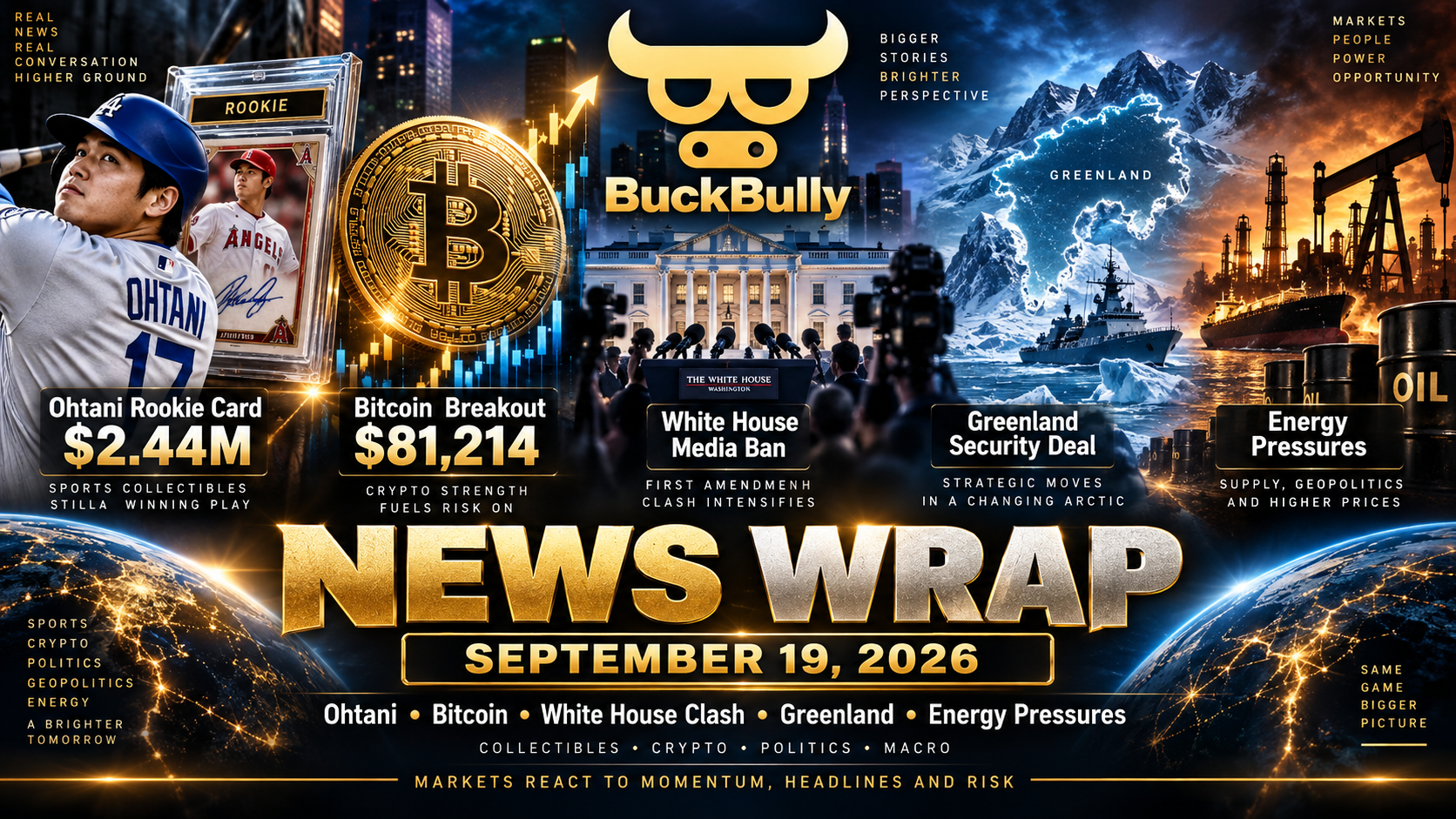
Today was one of those days where sports collectibles, crypto, politics and macro markets all collided.
This is he kind of headline mix that reminds you how connected modern markets have become. One story came from the collectibles world, where Shohei Ohtani once again proved he is more than just a superstar athlete — he is a full-blown market mover. Another came from crypto, where Bitcoin pushed through an important level and reignited talk of a broader breakout. At the same time, Washington added a major political flashpoint with a White House media ban, while developments tied to Greenland and the Middle East kept the geopolitical backdrop tense.
For BuckBully, the big takeaway is simple: money follows momentum, but momentum never moves in a vacuum. It reacts to culture, politics, fear, opportunity and headlines all at once.
Ohtani’s Rookie Card Sale Shows the Power of Elite Modern Collectibles
The sports-and-collectibles side of the story started with a monster result: a 2018 Bowman Chrome Shohei Ohtani Red Refractor rookie card, numbered to 5 and featuring a blue autograph, reportedly sold for $2.44 million today.
That kind of number is more than a sale. It is a statement.
It tells you that Ohtani has moved beyond normal star-athlete territory and into ultra-elite collectibles status. When collectors are willing to pay well into seven figures for a modern card, it confirms that scarcity, star power and global appeal can push a player into a different class of asset entirely.
Ohtani’s market keeps proving that modern cards can still command historic prices when the player is iconic enough. For the hobby, that matters. It keeps high-end baseball relevant, keeps investor money interested, and reinforces the idea that the right modern grail can sit in the same conversation as legendary vintage pieces.
Bitcoin’s Breakout Put Crypto Back in the Spotlight
On the crypto side, today has momentum day.
Bitcoin’s move to $81,214, up roughly 3.9% on the day, was notable not just because of the size of the gain, but because of what it suggested technically and psychologically. The move represented an important attempt to break a streak of weak quarterly performance and put Bitcoin back in position to challenge the narrative that crypto had been stuck in a prolonged cooldown.
When Bitcoin starts reclaiming key levels, the entire market mood changes.
Suddenly traders start talking about rotation. Suddenly altcoins get attention. Suddenly “dead money” becomes “early opportunity.”
That is how sentiment flips.
According to the market framing you provided, the rally also came with heavy short liquidations and solid ETF inflows, which is exactly the kind of fuel that can accelerate a move once bears are caught leaning the wrong way.
In plain English: shorts got squeezed, institutions helped support the move, and confidence came back fast.
Why Macro Relief Helped the Rally
A major part of that rally appears tied to the broader macro backdrop.
Oil prices had started easing after an earlier surge tied to Middle East supply fears, helping cool inflation concerns and reduce pressure on Treasury yields. Reuters reported that Brent crude fell back, closing at $104.87, after hopes grew that supply disruption from attacks on Saudi infrastructure might be limited. Reuters also reported that Houthi attacks near Riyadh and on Yanbu added to broader regional instability and kept energy infrastructure in focus.
That matters because when oil cools off, inflation fears often cool with it.
And when inflation fears cool, markets tend to breathe easier.
That creates room for risk assets — especially crypto and high-growth tech — to rally together.
So the Bitcoin move was not just a crypto story. It was also a macro story.
Tech and Risk Assets Benefited From the Same Mood Shift
This is where the market picture gets more interesting.
If falling oil and softer yield pressure gave investors relief, that same relief would naturally spill over into tech and growth stocks. That helps explain why Bitcoin strength, ETF interest and broader enthusiasm around names like AMD, Intel and Meta all fit together under one bigger theme:
The market was willing to take risk again.
That does not guarantee a lasting bull run.
But it does tell you the market was no longer trading like it was in full defense mode.
And when that shift happens, the strongest stories tend to attract the most capital.
On September 19, Ohtani and Bitcoin were two of the clearest examples of that.
White House Media Ban Turned Into a First Amendment Flashpoint
Outside the market, one of the day’s biggest political stories came from the White House.
Reuters reported that President Donald Trump announced a ban on CNN, MS NOW and Politico from White House access, accusing them of spreading “fake news.” Reuters then reported that White House officials enforced the move by turning away journalists from those outlets and confiscating credentials, while the targeted organizations called the action unconstitutional.
That instantly turned the story into more than a media-access dispute.
It became a larger argument over press freedom, retaliation and the limits of executive power. Reuters also reported that the affected outlets later sued the administration and that other major television networks refused to fill CNN’s pool-coverage slot in solidarity.
From a market perspective, political confrontation like that adds another layer of uncertainty. It may not move a stock chart by itself, but it absolutely shapes the broader environment investors are operating in.
Greenland Became a Strategic Story, Not Just a Geographic One
Another headline that stood out was the Greenland security development.
Reuters reported that Denmark and Greenland said a pending deal with the United States would not compromise Greenland’s sovereignty, even as the arrangement was set to significantly expand the U.S. military presence on the island and restrict adversarial military or strategic activity there.
That makes Greenland more than just a political headline.
It becomes a strategic and economic story too.
Why?
Because Greenland sits at the intersection of Arctic security, military positioning and critical resources. Whenever a deal like that makes headlines, investors immediately start thinking about defense, trade routes, rare earths and long-term geopolitical leverage.
Even if the average reader sees “Greenland” and thinks diplomacy, markets often see logistics, minerals and power projection.
Middle East Tensions Kept Energy Pressure Alive
At the same time, the energy story was still very much alive.
Reuters reported that oil markets remained highly sensitive after attacks damaged key Saudi pipeline infrastructure earlier in the week, while ongoing regional conflict kept traders focused on supply risk and tanker routes. Even with prices easing somewhat, the message was clear: the market still sees the global energy system as fragile.
That matters for everything else.
Higher fuel costs can squeeze consumers. Rising diesel prices can hit supply chains. Geopolitical energy shocks can spill into inflation. And inflation can change the entire direction of stocks and crypto.
So while September 19 felt like a “risk-on” day in parts of the market, it was still happening under a shadow of real geopolitical stress.
BuckBully Take
September 19 was not just a news day. It was a snapshot of how fast multiple worlds can overlap.
A seven-figure Ohtani rookie card sale showed the strength of elite collectibles. Bitcoin’s move reminded everyone that crypto can flip sentiment quickly. Falling oil helped reopen the door for risk assets. A White House media ban injected political tension into the national conversation. Greenland became part of the strategic chessboard. And Middle East instability kept energy markets on edge.
That is why BuckBully looks at markets the way it does.
Not as isolated categories. But as connected lanes.
Collectibles, crypto, politics, energy and equities all feed off the same thing: attention, confidence and perceived value.
Today all three were in motion.
BuckBully — Where Collectibles Meet Markets.
This article is for informational and entertainment purposes only and is not financial advice.