
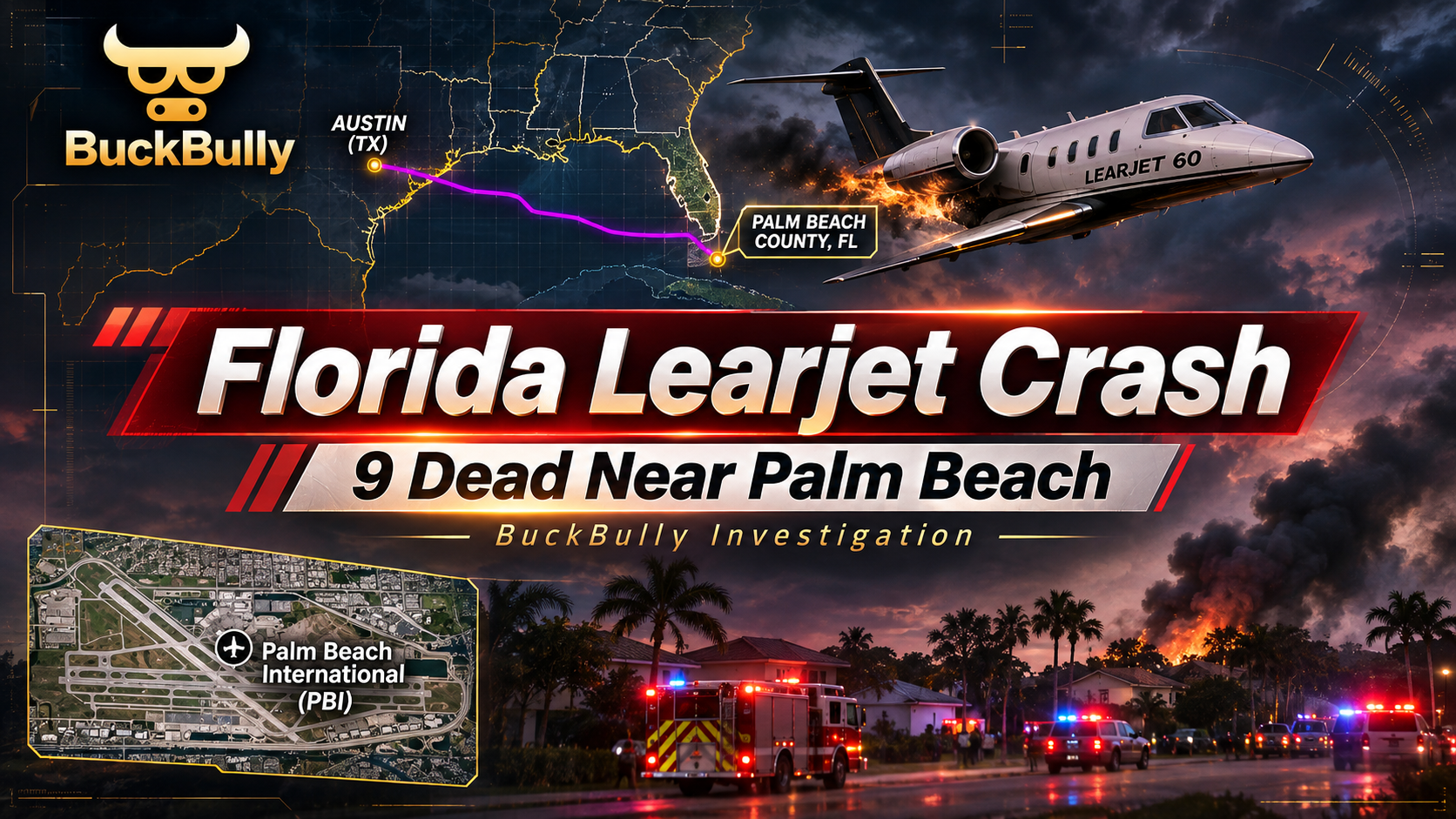
Florida Learjet Crash Kills Nine Near Trump’s Palm Beach Area: Accident, Mechanical Failure or Something More?
November 1, 2026 • Investigation and developing coverage
Our investigation examines reported air traffic control communications, extreme flight tracking, weather, eyewitness recordings and crash footage to separate evidence from speculation.
What Happened?
A Learjet 60 flying from Austin, Texas, toward North Eleuthera in the Bahamas crashed near Military Trail and 10th Avenue North in Palm Beach County on Sunday, November 1.
Transportation Secretary Sean Duffy confirmed nine deaths aboard the aircraft. The NTSB is leading the investigation, supported by the FAA.
The proximity to President Trump’s Palm Beach base has generated questions. However, geographic proximity is not evidence of an attack.
Investigation Desk
Our continuing analysis of verified facts, reported evidence, possible causes and unresolved questions.
Baseline analysis: November 1, 2026. Select Refresh Investigation to check for new coverage.
Latest Developments to Review
Investigation Notes — Evidence-Based Assessment
The pilot reportedly described light clear ice, moderate turbulence and weather-related difficulties while flying at high altitude. These statements support investigating an atmospheric or flight-control upset, but do not establish the precise mechanism.
The reported loss of roughly 27,000 feet in one minute, together with a declared overspeed emergency, suggests the aircraft entered an extreme flight condition. Investigators must determine whether it involved aerodynamic upset, flight-control malfunction, structural damage, or interacting factors.
Regional reporting described scattered storms and a stronger storm cell encountered before the descent. Proving a causal connection requires precise radar, atmospheric and onboard data.
The aircraft’s location near Trump’s Palm Beach area has drawn attention, but neither its reported route nor the available imagery establishes hostile action.
Official identification and crew records are needed before relying on social-media claims about the people operating the aircraft.
New Reporting Signals
Refresh uses a third-party news RSS gateway. If the gateway is unavailable, the baseline notes remain unchanged and the page reports the error. This is not an automated NTSB investigation or AI fact-checking service.
Interactive Crash Footage Examination
Three original uploaded clips. Use the player to slow the footage, step through the sequence and examine visible details.
00:00 / 00:00
Approximate frame stepping uses 1/30 second; actual file frame rates may differ. Digital zoom does not recover information absent from the original recording.
The roadway footage provides ground-level context around the event. Wet road conditions and the sudden impact sequence are observable. It cannot by itself identify the initiating failure at altitude.
Our Logical Reconstruction
The aircraft reportedly encountered ice, turbulence and precipitation. These can affect aerodynamic performance and operational workload, depending on the specific circumstances.
Reports describe a requested climb followed by an unexpected rapid descent. The transition is a crucial investigative interval.
The reported acceleration and overspeed are compatible with a severe flight upset. They are not sufficient to establish whether the original trigger was weather, hardware, aircraft handling or a combination.
Ground footage shows a devastating impact and fireball, while reporting describes extensive roadway damage. The images alone do not demonstrate an explosion before ground contact.
Compare the Crash Theories
The reported communications provide direct reason to investigate atmospheric conditions. Possible aircraft-performance effects and any interaction with flight systems remain undetermined.
The Trump Proximity Question
The crash occurred in the broader Palm Beach area, miles from Mar-a-Lago. President Trump reportedly departed the nearby airport aboard Air Force One more than an hour earlier.
Proximity, unusual timing and a dramatic impact do not establish a deliberate attack. A stronger allegation would require independently verifiable supporting evidence, such as evidence of sabotage, hostile interference or intentional diversion.
What the Investigation Must Still Answer
Did icing alter aircraft performance?
Investigators need weather reconstruction, onboard data, aircraft-system records and crew communications.
Did an autopilot, trim or flight-control system malfunction?
Wreckage and data analysis must establish whether systems operated normally and how the aircraft responded.
What happened during the extreme descent?
The sequence of airspeed, aircraft attitude, altitude and available crew responses must be reconstructed.
Were the aircraft occupants identified?
Names, crew roles and other personal details should be based on official identification, not unverified internet accounts.
Did any evidence indicate deliberate interference?
There is no publicly substantiated indication of an intentional attack in the reviewed reports. Investigators must rely on physical and corroborated evidence.
BuckBully’s Current Assessment
Our assessment will be revised when verified new evidence warrants it. The NTSB’s eventual findings, rather than circumstantial interpretations, will be decisive.
Credible Sources & Continuing Coverage
Associated Press — Crash Reporting
WPTV — Local Coverage and ATC Reporting