
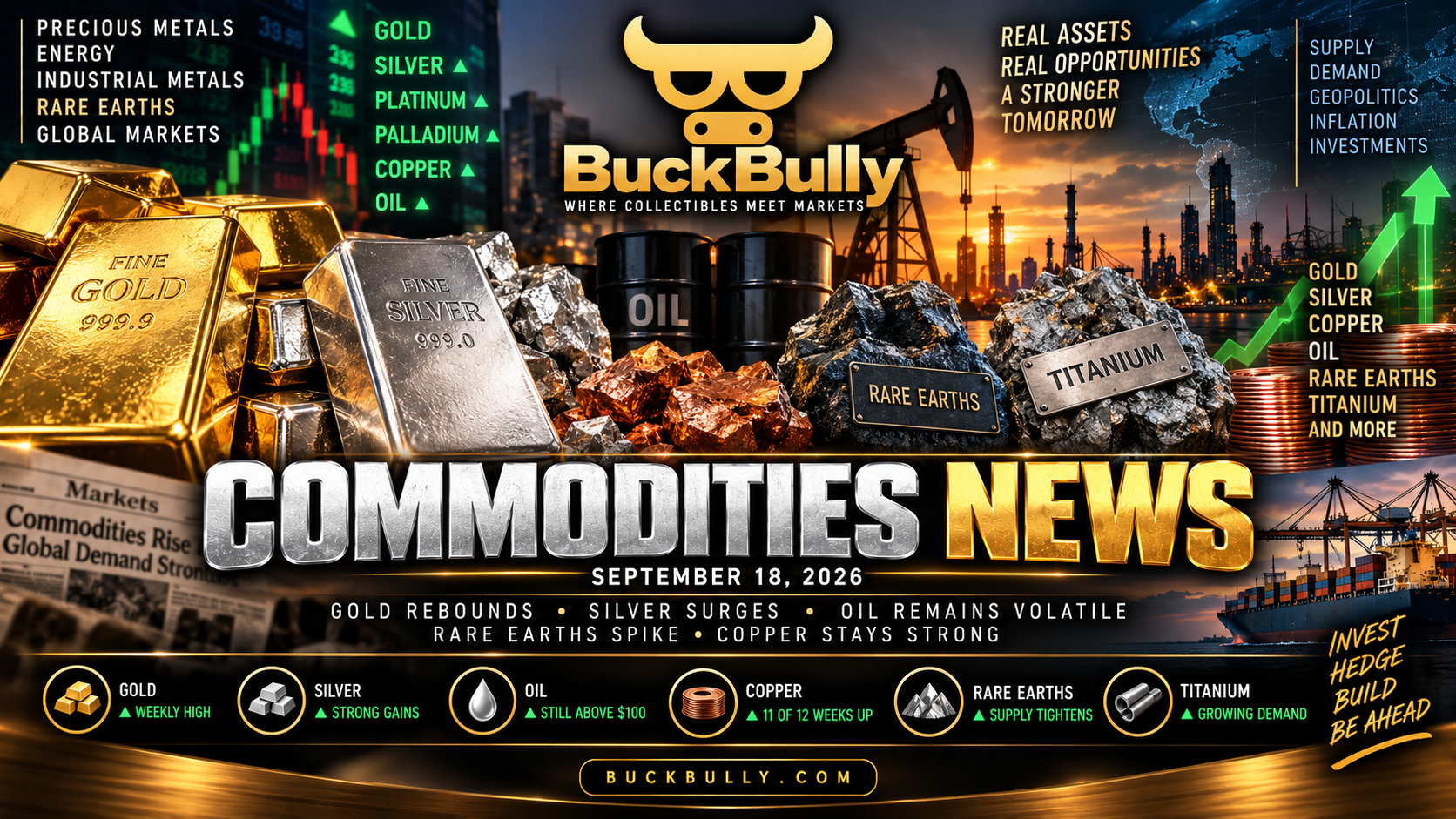
Precious metals rallied after the Fed hike, oil stayed above $100, copper extended its winning streak, and critical minerals became an even bigger story.
Today was a strong reminder that the commodities market is about much more than just gold.
Precious metals bounced sharply, crude oil remained volatile above $100 a barrel, copper continued one of its strongest stretches of the year, and rare-earth markets showed just how expensive supply shortages can become.
For BuckBully, the biggest takeaway is that commodities are being pulled in two directions at once: inflation and geopolitical risk are supporting hard assets, while changing supply conditions are creating major opportunities—and major volatility—across individual metals.
Gold Fights Back After the Fed Hike
Gold had a rough start to the week as markets priced in another Federal Reserve rate hike.
The Fed ultimately raised its target rate by 25 basis points to 3.75%–4.00%, but gold did something interesting after the decision: instead of continuing lower, buyers stepped back in.
By Friday, spot gold climbed to a one-week high and was headed for its first weekly gain in four weeks. Reuters reported spot gold around $4,390 per ounce, while U.S. gold futures settled around $4,425.
Fortune measured gold at roughly $4,381 per ounce Friday morning, nearly $721 higher than one year earlier.
That rebound matters.
A higher-rate environment normally creates competition for gold because bonds and cash begin offering better yields. But falling crude prices, easing Treasury yields and continued geopolitical uncertainty helped gold recover even after the Fed tightened policy.
In other words, traders appear unwilling to abandon gold just because rates moved higher.
Silver Was Even Stronger
Silver had one of the most impressive moves in the metals complex.
As of Friday morning, silver traded around $66.94 per ounce, up more than 4% from the prior day and roughly 60% above its level from a year earlier.
Unlike gold, silver has a much heavier industrial component.
It is used across electronics, solar technology and other manufacturing applications, meaning silver can benefit from both safe-haven demand and expectations for industrial growth.
That combination is one reason silver can move much faster than gold in either direction.
When precious metals catch momentum, silver is often where the volatility really shows up.
Platinum and Palladium Join the Rally
Gold and silver weren’t alone.
Friday morning prices showed platinum around $1,814 per ounce and palladium near $1,323.
Reuters later reported platinum up about 2.2% and palladium roughly 1.5% as the precious-metals complex moved higher.
These markets are much smaller than gold, so relatively small changes in supply or demand can create bigger percentage moves.
That makes platinum and palladium interesting—but also more volatile.
For BuckBully, these are metals worth watching when the broader precious-metals trade starts heating up because the smaller markets can occasionally produce outsized moves.
The Precious Metals Snapshot
Friday’s early market prices looked roughly like this:
Metal Sept. 18 price
Gold $4,381/oz
Silver $66.94/oz
Platinum $1,814/oz
Palladium $1,322–$1,323/oz
Prices varied slightly by time and market source during the session.
Oil Is Still the Wild Card
One of the biggest forces affecting the metals market right now isn’t a metal at all.
It’s crude oil.
Oil had surged toward four-month highs earlier in the week after attacks damaged Saudi Arabia’s East-West Pipeline and raised fears over Middle Eastern supply.
By September 18, those fears had eased somewhat. Brent crude eventually closed around $104.87 a barrel, while West Texas Intermediate finished near $100.30.
Prices initially dropped more sharply during Friday’s session as traders reacted to signs that Saudi Arabia could move more crude through alternative export routes.
Why does that matter for gold?
Lower oil prices can ease inflation expectations.
And if inflation pressure comes down, Treasury yields can cool, taking some pressure off precious metals.
That relationship helped gold rebound late in the week.
But oil still above $100 means the inflation story is far from dead.
Copper Quietly Keeps Winning
Copper may not get the same headlines as gold, but its recent run has been difficult to ignore.
On September 18, copper recorded its 11th weekly gain in the previous 12 weeks, helped by signs of improving Chinese demand. Benchmark London Metal Exchange copper settled around $14,521.50 per metric ton.
Copper is one of the most economically sensitive commodities in the world.
Construction, power grids, data centers, electric vehicles and electronics all require enormous amounts of it.
That means copper strength can sometimes point toward expectations for industrial activity rather than simple fear-driven buying.
Gold moving higher while copper remains strong creates an interesting combination:
Investors are hedging uncertainty while industrial metals are still pricing significant demand.
Rare Earth Prices Are Flashing Warning Signs
Some of the most extreme moves are happening away from the traditional precious-metals market.
Dysprosium oxide recently traded at $3,250 per kilogram in North America, versus an August Platts assessment of $2,300/kg.
Terbium oxide changed hands at an even more dramatic $7,500 per kilogram.
These aren’t household metals like gold or silver.
But they are strategically important.
Dysprosium and terbium are used in high-performance permanent magnets required in technologies such as electric vehicles, aerospace systems and advanced electronics.
S&P Global reported that traders are increasingly focused on limited supplies of material exported from China before restrictions were introduced.
That is exactly what a supply squeeze looks like.
And it shows why rare earths deserve attention alongside traditional commodities.
Titanium Is Becoming Another Strategic Metal Story
Titanium also made headlines September 18.
Empire Metals said it had developed a processing approach for its massive Pitfield titanium project in Western Australia.
The deposit contains an estimated 8.16 billion metric tons of ore and roughly 349 million metric tons of contained titanium dioxide, according to the project’s resource estimate.
The company says its process could reduce sulfuric acid consumption by approximately 50%, while separating roughly 90% of mined material early in the process.
Empire is targeting a potential investment decision in 2027.
Titanium demand is particularly important in aerospace, where demand is estimated to be growing around 7% annually.
That adds another metal to the growing list of strategic resources investors should be watching.
The Bigger Commodity Story
What makes September 18 interesting is that there isn’t just one commodity theme.
Gold is acting as a hedge.
Silver is combining investment and industrial demand.
Copper is responding to economic activity.
Oil is trading geopolitical risk.
Rare earths are reacting to supply restrictions.
Titanium is benefiting from aerospace and strategic-resource demand.
Different commodities are moving for different reasons.
And that is why simply saying “commodities are up” doesn’t tell the entire story.
BuckBully Commodities Radar
The areas that stand out most right now are gold, silver, copper, palladium, rare earths and titanium, with crude oil continuing to act as one of the biggest macro catalysts.
Gold remains the defensive anchor.
Silver offers more upside volatility.
Copper remains one of the clearest ways to watch industrial demand.
Rare earths may have the most severe supply constraints.
And titanium could become increasingly important as aerospace and strategic manufacturing expand.
But after large moves, discipline matters.
A commodity can have a great long-term story and still be overpriced in the short term.
That is especially true when geopolitical headlines are moving markets overnight.
BuckBully Take
September 18 showed why commodities deserve their own place beside stocks, crypto and collectibles.
Gold rebounded despite the Fed hike.
Silver broke higher.
Copper continued its impressive streak.
Oil remained above $100.
And lesser-known strategic metals showed signs of increasingly tight supply.
The common thread is scarcity.
Whether we’re talking precious metals, energy or critical minerals, investors are paying more attention to assets that are difficult, expensive or politically complicated to produce.
And when supply can’t respond quickly, prices can move fast.
BuckBully — Where Collectibles Meet Markets.
This article is for informational and entertainment purposes only and is not financial advice.