
Bitcoin Battles the Fed While Stablecoins Go Mainstream 🐂₿
Crypto has spent years trying to prove it can become more than speculation.
This week gave us a pretty good picture of what that future might look like.
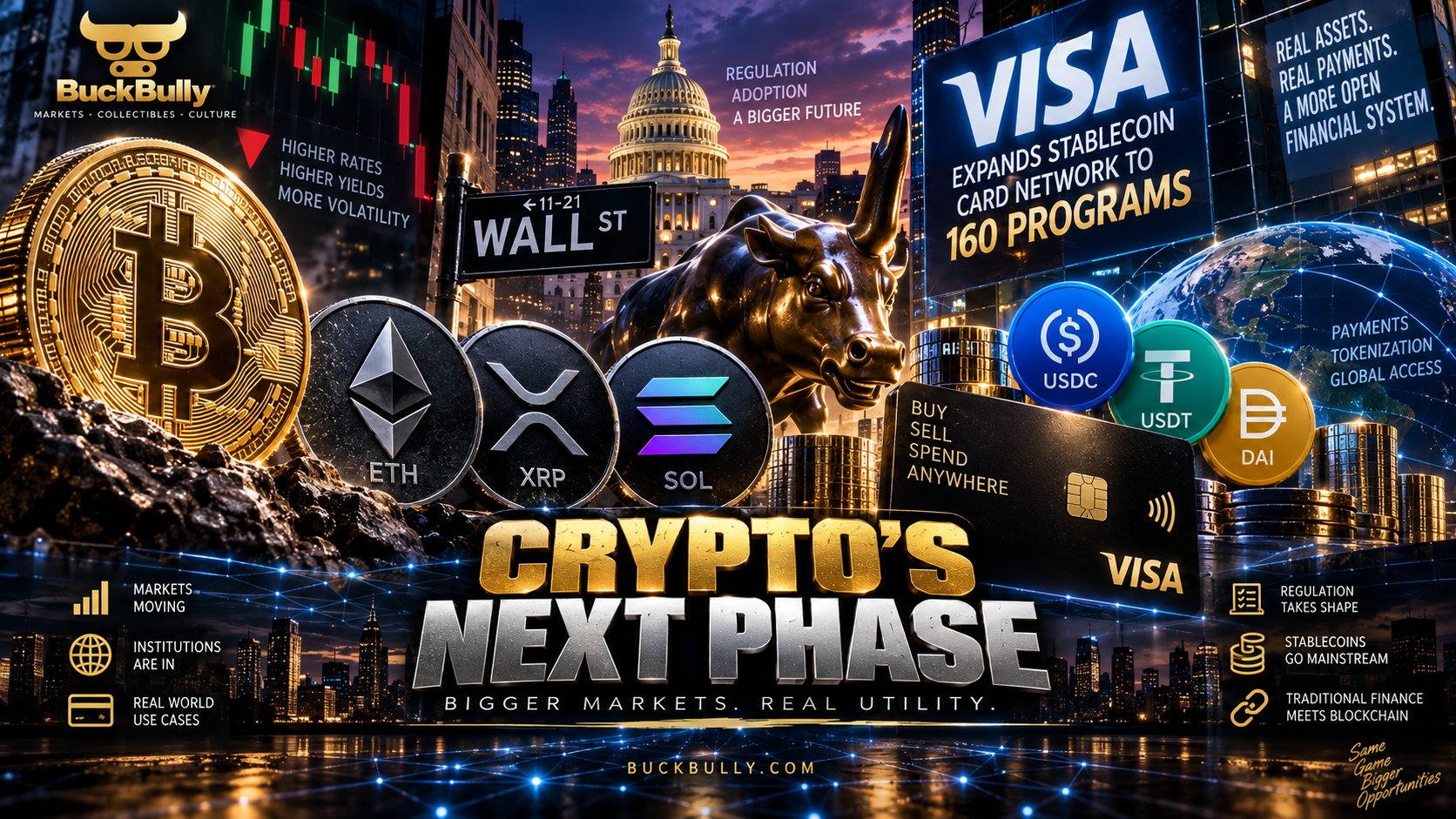
Bitcoin is battling inflation, rising Treasury yields and expectations for another Federal Reserve rate hike. Ethereum, XRP and Solana are under pressure. At the same time, stablecoins are quietly moving deeper into the traditional financial system, with now supporting more than 160 stablecoin-linked card programs.
And there’s an even bigger theme developing:
Wall Street isn’t waiting for crypto to replace traditional finance. It’s starting to connect the two.
BITCOIN IS BACK UNDER PRESSURE 📉
Bitcoin’s latest rally has run into another macroeconomic wall.
BTC dropped below $77,000 Thursday as hotter producer inflation pushed Treasury yields higher and increased expectations that the Fed could raise interest rates again.
The damage wasn’t limited to Bitcoin. Ether traded around $2,445, XRP around $1.34 and Solana slipped below $100 during the selloff. CoinDesk reported that 95 of the CoinDesk 100 assets declined over the previous 24 hours.
The reason matters.
This wasn’t another crypto exchange collapsing or some blockchain getting hacked.
It was traditional macroeconomics.
Higher inflation → higher interest-rate expectations → higher Treasury yields → less appetite for risk.
When investors can earn attractive yields from government debt, speculative assets have to work harder to attract capital.
BUT BITCOIN IS ACTING DIFFERENTLY
Something interesting happened earlier this week.
As Brent crude broke $100 and stocks declined, Bitcoin briefly moved with gold instead of equities, climbing toward $80,000 while traditional risk assets struggled.
That’s worth watching.
Bitcoin has spent much of its history behaving like a high-volatility technology investment.
But Bitcoin’s supporters have always argued that eventually it could behave more like digital gold.
We’re nowhere near proving that transition has happened permanently.
But periods where Bitcoin holds up during equity weakness strengthen that argument.
For BuckBully, the question is simple:
Is Bitcoin becoming an alternative asset—or is it still primarily a risk asset?
The next recession or major financial shock may eventually answer that question.
THE $76K LINE MATTERS 👀
Technically, Bitcoin is approaching an important area.
Analysts cited by CoinDesk identified roughly $76,270 as an important support level following the August rally.
I’d simplify the current setup:
$76K-$77K = defend it.
$80K = reclaim it.
$83K-$84K = prove the bulls are really back.
If Bitcoin loses the mid-$70Ks decisively, I’d expect another round of fear.
If it absorbs higher rates and works its way back through $80K, that becomes much more interesting.
STABLECOINS MAY BE THE BIGGER STORY 💳
While everybody watches Bitcoin candles, one of crypto’s most important developments is happening somewhere much less exciting:
payments.
Visa announced this week that more than 160 stablecoin-linked card programs now operate on its network.
Payment volume from those programs has increased nearly 200% year over year.
Read that again.
We’re no longer talking about whether somebody might eventually spend digital dollars using a normal payment card.
It’s already happening.
Stablecoins can sit behind the transaction while the consumer experiences something familiar:
Swipe. Tap. Buy.
That’s potentially how blockchain adoption reaches millions of people who couldn’t care less what blockchain they’re using.
VISA IS GOING EVEN DEEPER
Visa’s announcement goes beyond cards.
The company is combining VisaNet settlement information with onchain lending infrastructure to help stablecoin-connected fintech companies access working capital.
Visa says more than $694 billion in stablecoin-denominated loans have moved through onchain lending protocols since 2020.
That’s where this starts getting bigger than crypto trading.
Blockchain isn’t only being positioned as something people invest in.
It’s increasingly becoming infrastructure for:
payments → lending → settlement → tokenization → global money movement.
That’s an entirely different investment thesis.
THE BANKS AREN’T IGNORING IT ANYMORE 🏦
Here’s another development I think crypto investors should pay attention to.
A consortium of 21 financial institutions, including Goldman Sachs, Bank of America, Citi and Deutsche Bank, plans to establish a company supporting a dollar-backed stablecoin targeted for 2027.
Think about how much the conversation has changed.
The old debate was:
Crypto vs. banks.
The emerging reality looks more like:
Banks using crypto infrastructure.
That’s potentially much more important.
The future may not involve traditional finance disappearing.
It could involve traditional finance adopting blockchain technology underneath the system.
TOKENIZATION COULD BE THE NEXT GIANT MARKET
Stablecoins are only one piece.
South Korea is preparing infrastructure aimed at allowing tokenized stocks and bonds to settle using stablecoins beginning in 2027.
That’s the bigger idea behind tokenization.
Stocks.
Bonds.
Real estate.
Commodities.
Collectibles.
Currency.
Eventually, almost anything representing ownership could theoretically exist as a programmable digital asset.
And that fits directly into what we talk about at BuckBully:
What creates value? Who owns it? How easily can ownership move?
Blockchain could eventually change the answer to that last question dramatically.
XRP AND THE PAYMENT QUESTION
This stablecoin expansion also creates an interesting question for XRP holders.
XRP’s original investment thesis revolves heavily around efficient cross-border settlement.
Stablecoins increasingly attack some of the same problems.
That doesn’t automatically make stablecoins bad for XRP.
But it does increase competition.
If banks can move tokenized dollars directly across blockchain networks, investors need to ask:
Where does XRP provide something those stablecoins cannot?
That’s the question I’d watch rather than simply assuming every expansion of blockchain payments automatically benefits XRP.
ETHEREUM: WATCH THE INFRASTRUCTURE, NOT JUST THE PRICE
Ethereum may have one of the most interesting long-term positions in this transition.
ETH is currently struggling alongside the broader crypto market, but Ethereum’s investment case increasingly depends on whether tokenization, stablecoins, DeFi and other financial applications continue moving onchain.
That’s why ETH shouldn’t only be judged by:
“Will Ethereum hit $5,000?”
The more useful question is:
“How much economic activity will eventually settle on Ethereum and its surrounding ecosystem?”
Price follows speculation in the short run.
Long-term value ultimately needs usage.
SOLANA: SPEED VS. VOLATILITY
Solana has fallen below the psychologically important $100 level during the latest pullback.
That hurts.
But SOL remains one of the networks worth watching because consumer-facing blockchain applications need exactly what Solana emphasizes:
speed + low transaction costs + scale.
The risk is equally obvious.
Higher-beta crypto assets usually get hit harder when liquidity disappears.
If Bitcoin loses support, SOL could experience significantly more volatility.
If crypto liquidity returns, those same characteristics can work in the opposite direction.
WASHINGTON COULD MOVE THE ENTIRE MARKET 🏛️
Crypto’s next major catalyst isn’t only the Fed.
The Senate is preparing for a September 15 procedural vote on the Clarity Act, legislation intended to establish clearer definitions for digital assets and determine which regulators oversee them.
Crypto companies and banks are lobbying heavily around the legislation, although Reuters reports its prospects remain uncertain because lawmakers continue debating consumer protections and potential banking-system risks.
This matters.
Crypto has spent years operating under the question:
“What will regulators eventually allow?”
Clear rules—even strict ones—could remove some uncertainty institutions hate.
But poorly designed rules could also restrict innovation.
September 15 could therefore become another important date on the crypto calendar.
🐂 THE BULL CASE
There’s plenty for crypto bulls to work with.
Institutional adoption continues.
Stablecoin payments are growing.
Visa is expanding blockchain infrastructure.
Major banks are developing stablecoins.
Tokenized securities are advancing.
Bitcoin continues attracting institutional capital.
And regulators are finally being forced to define how digital assets fit into traditional finance.
That’s not the same crypto market we had five years ago.
The technology is moving deeper into the financial system even while token prices struggle.
🐻 THE BEAR CASE
Don’t ignore the other side.
Bitcoin remains vulnerable to higher interest rates.
Treasury yields near 5% create genuine competition for capital.
Crypto ETF outflows have appeared during recent weakness.
Altcoins remain extremely volatile.
Stablecoins could eventually compete with existing payment-oriented cryptocurrencies.
And regulators are increasingly concerned that deeper integration between crypto and traditional finance could allow problems in one market to spread into the other.
Mainstream adoption creates opportunity.
It also creates mainstream risk.
THE BUCKBULLY TAKE 🐂
I’m watching two crypto markets at the same time.
The first is the one everybody sees:
Bitcoin. Ethereum. XRP. Solana. Prices going up and down.
The second may ultimately be more important:
Stablecoins. Payments. Tokenization. Lending. Settlement. Financial infrastructure.
Crypto’s biggest victory may not eventually be Bitcoin reaching some crazy price target.
It could be blockchain becoming so deeply embedded in everyday finance that people use it without even realizing they’re using crypto.
Visa supporting 160+ stablecoin card programs is another step in that direction.
That’s why I’m not judging the future of crypto solely by whether Bitcoin is $77,000 or $87,000 next month.
I’m watching who is building, who’s adopting, where the money is moving and what real-world problems blockchain is actually solving.
The speculative phase created crypto.
The utility phase could determine whether it lasts.
Buy carefully. Hold with a thesis. Follow the technology—not just the hype.
Be Bullish On What You Value. 🐂₿
BuckBully content is for informational and entertainment purposes only and isn’t financial or investment advice.