
What Is Wall Street Seeing? 🐂📈
Wall Street finally caught a break Friday.
After four straight losing sessions, stocks bounced sharply, oil backed away from its recent surge, and investors appeared willing to look beyond another uncomfortable inflation report.
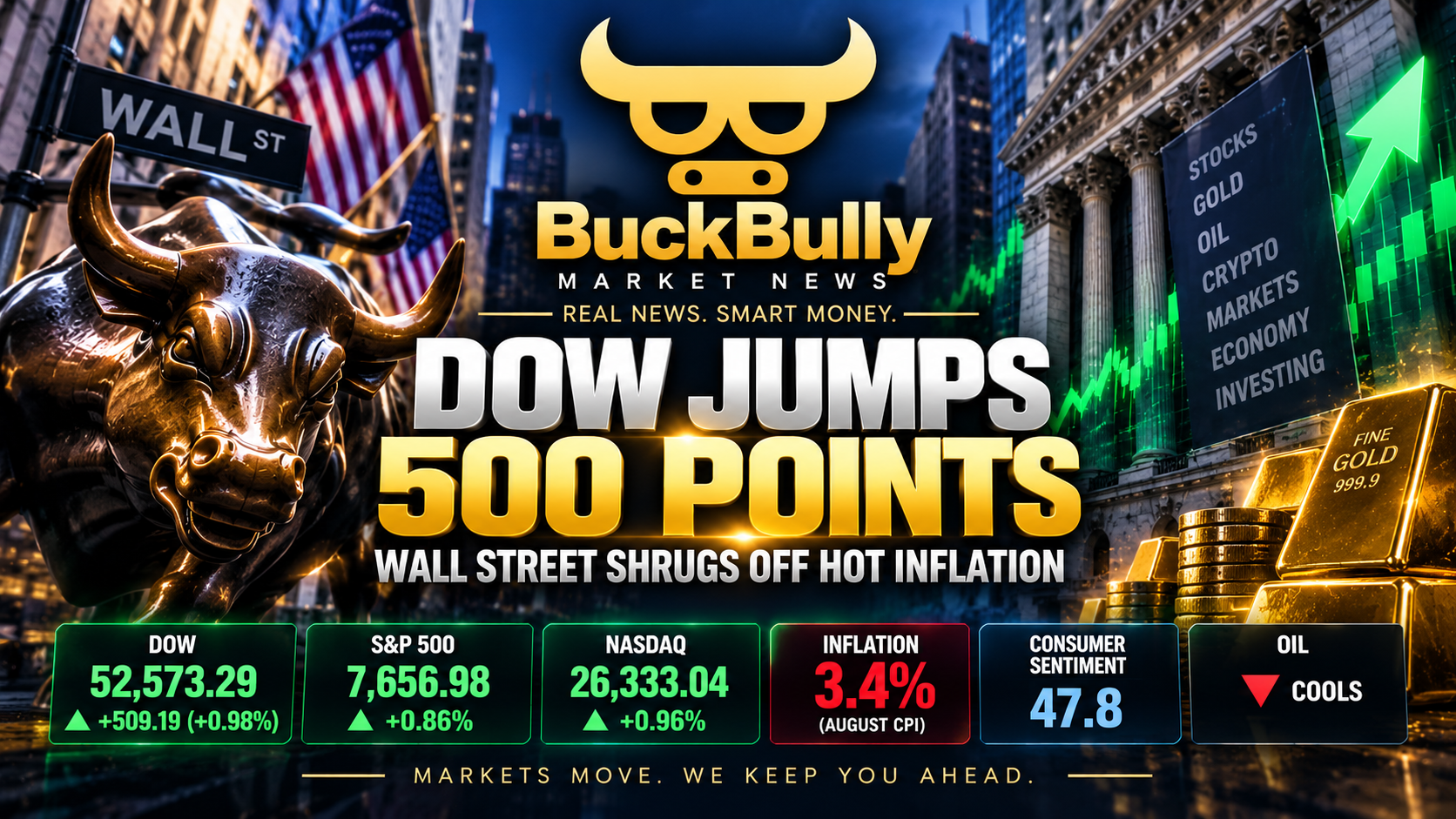
The Dow jumped 509 points, or 0.98%, to 52,573.29. The S&P 500 gained 0.86% to 7,656.98, while the Nasdaq climbed 0.96% to 26,333.04. (The Wall Street Journal)
But here’s what makes September 11 interesting:
Inflation didn’t get better. Expectations for a Federal Reserve rate hike actually increased — and stocks rallied anyway.
Welcome to a market where sometimes bad news isn’t bad enough to be bad news.
🔥 Inflation Is Still Stubborn
August’s Consumer Price Index increased 0.4% for the month and 3.4% from a year earlier. Core inflation, excluding food and energy, increased 0.3% monthly and 2.4% annually. (Reuters)
The headline number largely matched expectations, but underlying inflation was firm enough to strengthen expectations that the Fed could raise interest rates at its upcoming meeting.
By Friday, futures markets were pricing roughly an 87% probability of a Fed hike. (The Wall Street Journal)
Normally, higher rates aren’t exactly something stock investors celebrate.
So why did the Dow jump 500 points?
🛢️ OIL FINALLY COOLED DOWN
Oil may have been Friday’s real hero.
After eight consecutive winning sessions, U.S. crude fell $2.43, or 2.4%, to $100.05 per barrel.
That’s still expensive — and crude finished the week up roughly 9.4% — but simply stopping the relentless climb provided some relief. (The Wall Street Journal)
Brent also retreated roughly 3% after exceeding $108 on Thursday. (Reuters)
That’s important because $100+ oil can ripple throughout the economy:
Fuel → transportation → manufacturing → food → consumer prices.
Falling oil doesn’t erase the inflation problem, but Friday’s decline reduced fears that energy prices were about to accelerate uncontrollably.
📈 THEN THERE’S THE 5% PROBLEM
This may be the number BuckBully investors should watch even more closely than the Dow.
The 10-year Treasury yield is flirting with 5%.
It reached roughly 4.98% Friday before retreating toward 4.93%. (Reuters)
Why should somebody who doesn’t own Treasury bonds care?
Because Treasury yields influence borrowing costs throughout the economy.
Mortgages.
Business loans.
Corporate debt.
Auto financing.
And the valuations investors are willing to pay for stocks.
The closer yields move toward 5%, the more competition stocks face from relatively safer fixed-income investments.
That’s why 5% could become one of the market’s biggest psychological lines.
🤔 WHY DID STOCKS RISE IF A RATE HIKE IS COMING?
Because markets hate uncertainty almost as much as they hate higher rates.
Investors spent much of this week wondering whether inflation might come in dramatically hotter than expected.
It didn’t.
The CPI report wasn’t particularly good — but it wasn’t catastrophic either.
Reuters described the reaction as a collective relief that inflation hadn’t surged beyond expectations. (Reuters)
The market may now be thinking:
“Fine. Raise rates. Just tell us what we’re dealing with.”
There’s even a bullish argument that another rate increase could reinforce the Fed’s inflation-fighting credibility rather than allowing inflation expectations to become unanchored. (Barron’s)
That’s a very different narrative from:
Rate hike = stocks crash.
Markets are rarely that simple.
🥇 GOLD ISN’T BACKING DOWN
Gold also deserves attention.
Despite higher yields and growing rate-hike expectations — conditions that can normally pressure precious metals — gold remained around $4,300+ per ounce.
Kitco reported spot gold around $4,337 following the inflation report, up about 0.5% at the time. (Kitco)
And another warning signal emerged Friday.
Preliminary U.S. consumer sentiment dropped to 47.8, while inflation expectations increased. (Kitco)
That’s an uncomfortable combination:
Consumers feel worse + consumers expect higher prices.
It helps explain why gold continues attracting attention even with interest rates elevated.
🐂 THE BULL CASE
Friday demonstrated that buyers haven’t disappeared.
Stocks absorbed:
$100 oil.
Near-5% Treasury yields.
3.4% inflation.
Higher rate-hike expectations.
Middle East uncertainty.
And the Dow still gained more than 500 points.
That’s meaningful.
The market could also benefit if oil continues retreating and investors become confident that one more Fed hike can contain inflation without causing a recession.
There’s another encouraging fact: despite this week’s volatility, the S&P 500 remains up about 11.9% in 2026, while the Nasdaq is up roughly 13.3% and the Dow about 9.4%. (AP News)
The bull market has taken some punches.
It hasn’t gone down yet.
🐻 THE BEAR CASE
Don’t confuse one green day with the end of the problem.
Even after Friday’s rally, all four major U.S. indexes finished the week lower.
The S&P 500 lost roughly 0.8% for the week, the Dow 1.6%, Nasdaq 0.7%, and Russell 2000 2.4%. (AP News)
Oil remains around $100.
The 10-year remains dangerously close to 5%.
Inflation remains above the Fed’s comfort zone.
And Middle East disruptions could send energy prices higher again.
If oil resumes climbing while Treasury yields break decisively above 5%, stocks could face a much tougher test.
👀 THE BUCKBULLY WATCHLIST
Going into next week, I’d reduce this complicated market to four numbers:
OIL — $100: Can crude fall back below it, or does $100 become support?
10-YEAR — 5%: A sustained move above 5% could pressure stocks, housing and borrowing.
INFLATION — 3.4%: Does energy push the next reading higher?
FED — ~87%: Markets are overwhelmingly expecting a rate increase. What matters now is what the Fed says comes next. (The Wall Street Journal)
And that last question may determine the market’s next major move.
THE BUCKBULLY TAKE 🐂
September 11 gave investors an unusual combination:
Hotter inflation.
Higher rate-hike expectations.
Falling oil.
Rising stocks.
Strong gold.
It looks contradictory until you remember that markets don’t trade solely on whether news is good or bad.
They trade on whether reality is better or worse than what investors already feared.
Thursday, investors feared $100+ oil could keep climbing, inflation could surprise dramatically higher, Treasury yields could blow through 5%, and stocks could extend their losing streak.
Friday removed some of those worst-case scenarios.
That’s enough to produce a rally.
But it doesn’t mean the warning lights disappeared.
The next battle is shaping up around oil, 5% Treasury yields and the Federal Reserve.
If oil cools and yields stabilize, Friday’s bounce could have legs.
If both turn higher again, the market may quickly remember why it spent the previous four sessions falling.
Watch the market. Understand the story behind the numbers.
Be Bullish On What You Value. 🐂
BuckBully content is for informational and entertainment purposes only and is not financial or investment advice.