
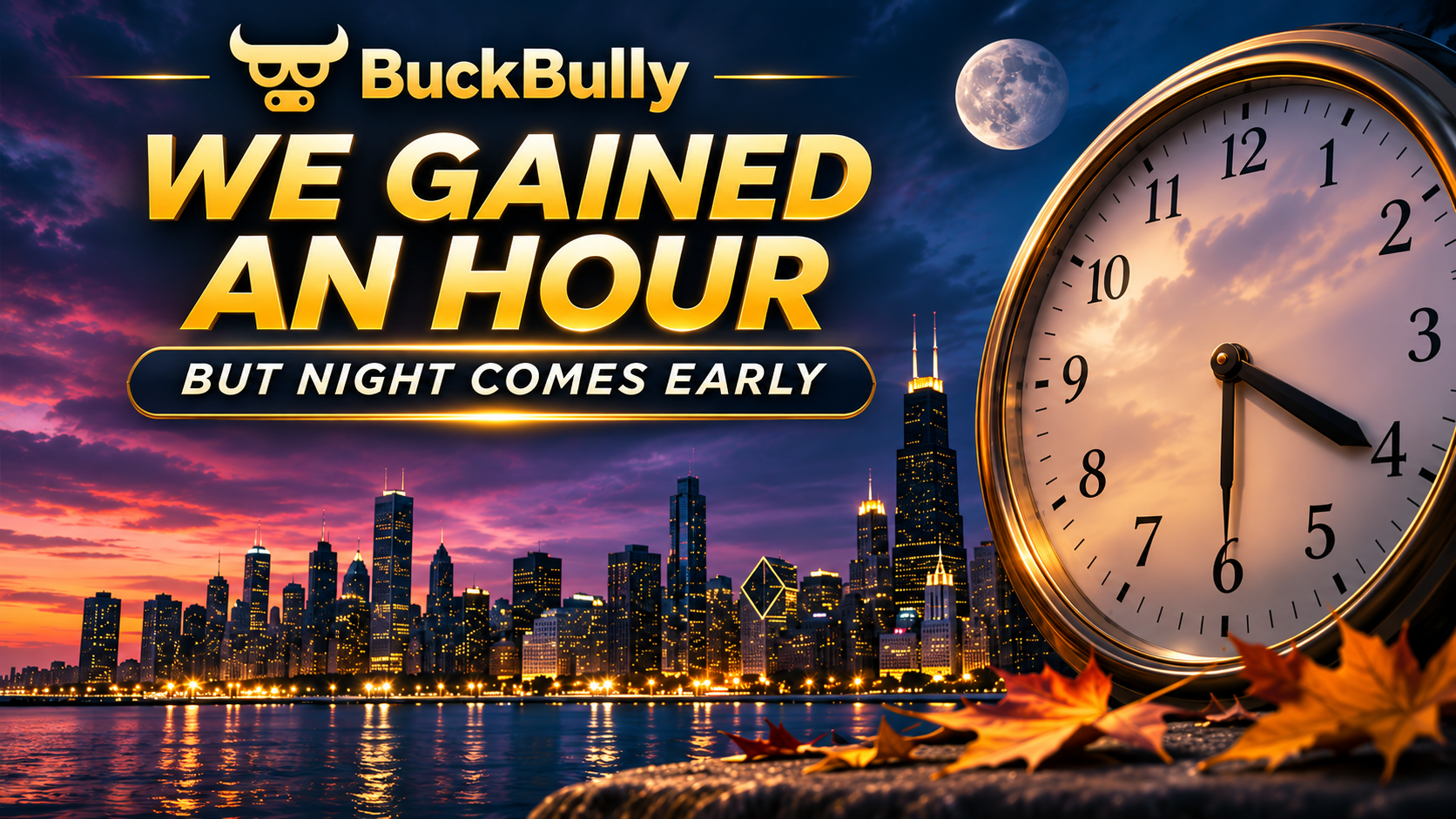
We Gained an Hour, But Are We Losing Our Sense of Time?
Daylight Saving Time is over. The clocks moved backward, but our daily lives didn’t slow down. Now Americans must adjust to a world where nighttime appears to arrive before the workday is even finished.
At 2 a.m. on Sunday, November 1, 2026, clocks across most of America fell back one hour. We were handed an extra hour, but by late afternoon, many of us will feel as though the day has been cut short.
1. Welcome to the 4 PM Twilight
Picture getting off work, checking your phone and realizing it’s only 4:30 p.m., yet the sky is already darkening. Streetlights begin switching on, headlights appear, and the evening feels much later than it actually is.
For some people, the moon will already be visible at 4 p.m. But the moon can also appear during the daytime throughout the year, depending on its phase and position.
Interactive: November Sunset Tracker
Slide through November to see how early sunset arrives around Chicago. Times are approximate and rounded.
Visualization shows the approximate portion of 8 a.m.–8 p.m. before sunset. Sunset estimates are illustrative, not a live astronomy feed.
2. Did We Really Gain an Hour?
Technically, yes. The transition repeats one clock hour. But after the adjustment, our daily schedules remain largely unchanged. A person who works until 5 p.m. still works until 5 p.m. The difference is that sunset arrives one hour earlier by the clock than it would have without the adjustment.
Before and After the Clock Change
Illustrative comparison of sunset clock times in Chicago, with bars showing relative position on a shared afternoon time scale.
3. Interactive: How Much Daylight Remains After Work?
Choose your departure time and see whether the sun will still be above the horizon.
Uses the date selected in the November Sunset Tracker above. Twilight can remain visible after sunset.
4. The Psychological Clock
Our internal body clock responds strongly to light and darkness. Morning sunlight helps establish alertness, while changes in evening light can influence sleep timing and routines.
Moving clocks backward can make mornings brighter by the clock while making evenings darker. That trade-off can affect people differently depending on their work schedule, age, sleep patterns and sensitivity to seasonal changes.
Potential Daily Effects
Sleep timing Mood Commutes Exercise routines Family schedulesThese are areas that can be affected by daylight timing. Not everyone experiences the same effect.
What Can Help?
Get outdoor morning light when possible, keep a regular sleep schedule, maintain physical activity, and plan safe, well-lit routes for evening travel.
5. Interactive: When Does Darkness Catch Your Schedule?
Evening Activity vs. Sunset
Select an activity time. Compare whether that activity begins before or after sunset on the selected November date.
6. Is Time or Weather Being Manipulated?
This question deserves an important distinction. Daylight saving time is a human-made scheduling rule. Governments decide where and when civil clocks change. In that sense, our official timekeeping is intentionally adjusted.
But changing the clock does not physically change the sun’s position, Earth’s tilt, atmospheric conditions or weather systems. Seasonal sunlight changes are driven primarily by Earth’s axial tilt and orbit, while daily weather depends on atmospheric processes.
What can change is how we experience the weather. A colder afternoon may feel especially gloomy when daylight disappears sooner relative to our work and school schedules. A sunny morning may feel more welcoming when the clock shows an earlier hour.
Clock Adjustment vs. Nature
Comparison shows the approximate overnight shift in sunset clock time versus the small seasonal change in actual sunset timing from one day to the next. Not a measurement of weather manipulation.
7. The Sunset Curve: November in Chicago
Watch the sunset clock time move earlier through the month. Drag the day slider above to highlight a point on the graph.
Calculated illustration with a smooth approximation between the start and end of November. Actual sunset progression is nonlinear.
8. What Can We Do About It?
The debate over permanent standard time versus permanent daylight saving time isn’t just about convenience. It affects morning sunlight, evening recreation, school start times, commuting conditions and the way our routines align with daylight.
Permanent daylight saving time would give later evening sunset clock times but later winter sunrises. Permanent standard time gives earlier winter morning light, which many sleep researchers favor for circadian alignment.
Regardless of the policy, the natural shortening of daylight during autumn and winter would continue.
Final Thought: The Clock Changed, But Did Our Lives Improve?
We gained an hour, yet many of us feel as though time is moving faster. We wake up, go to work, return home, and before we know it, darkness has arrived.
Maybe the bigger question isn’t whether we should move the clock forward or backward. Maybe it’s whether society should rethink how our daily schedules interact with natural daylight.
At BuckBully, we’re watching more than the hands on the clock. We’re looking at how time influences the way we live.
BUCKBULLY | Science, Lifestyle & Society | November 1, 2026. Times are approximate for Chicago and should not be interpreted as live astronomical measurements.