
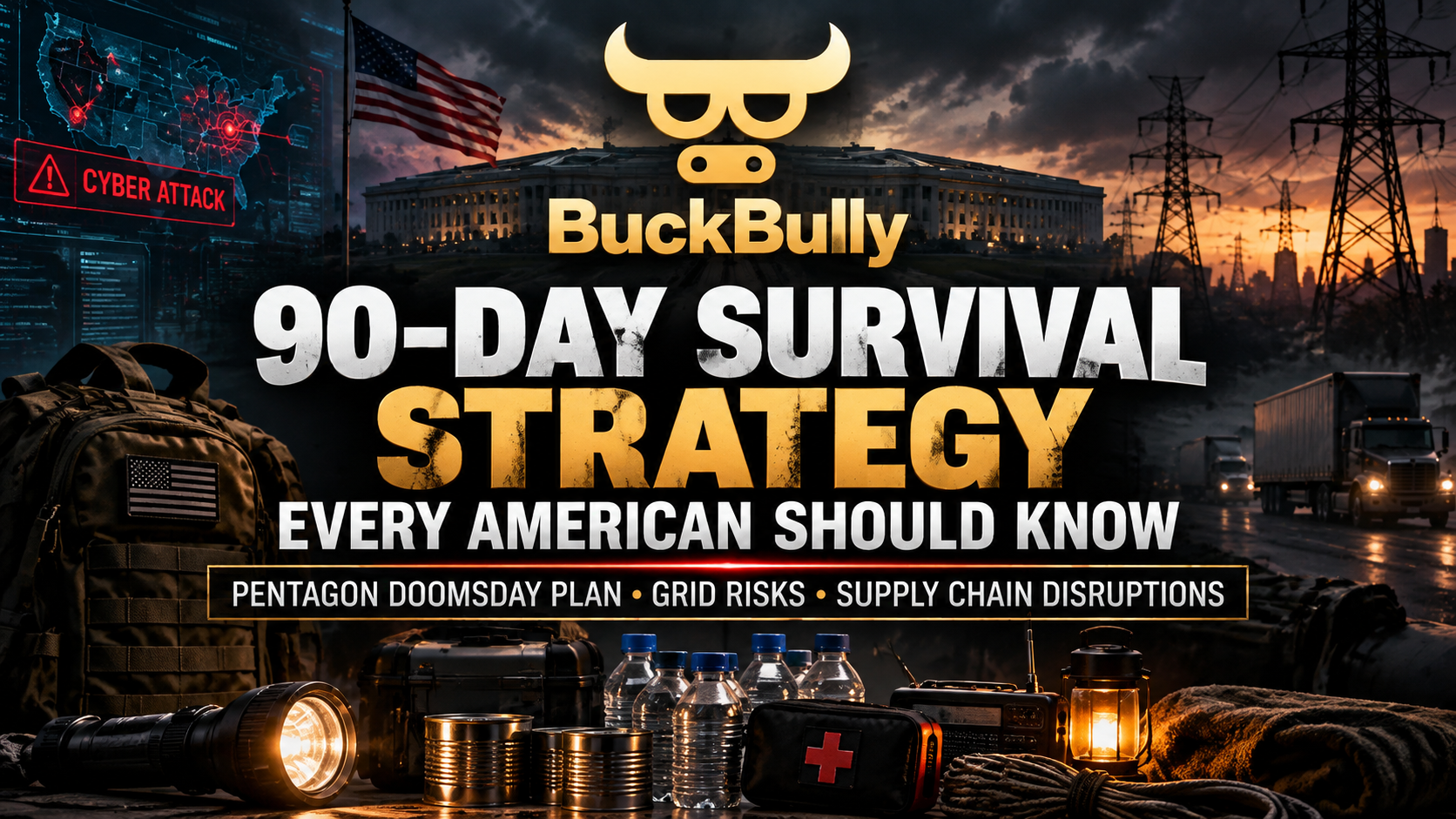
THE PENTAGON’S DOOMSDAY PLAN
Nuclear threats. Cyberattacks. Power-grid collapse. Long-range weapons. Supply chains under siege. Why America’s military is preparing for extreme disruption — and how households can build a 90-day survival strategy.
What happens when the lights go out — and don’t come back on for weeks?
That’s no longer just the premise of a disaster movie. America’s national security planners are evaluating how military installations can continue operating through extended emergencies without depending on the ordinary systems that power everyday life.
The Pentagon’s reported FORTRESS America initiative includes a goal of enabling critical military installations to sustain essential operations for at least 90 days without external power or supply support.
At BuckBully, we’re looking at the bigger picture. If military installations need contingency plans for a prolonged crisis, how prepared are American households?
Why the Pentagon is Planning for 90 Days
Modern national defense depends on far more than soldiers and weapons. Bases need electrical power, clean water, fuel, medical supplies, communication systems, repair parts, and transportation.
The goal is continuity: if commercial infrastructure fails, essential defense operations must continue. The same principle applies at home, although household preparedness needs and resources are very different.
America’s Five Major Security Threats
Tap each threat to explore how it might affect the country and what can reduce household exposure.
01 — Nuclear & Long-Range Missile Threats
Advanced ballistic missiles, cruise missiles, and other long-range weapons could threaten critical military infrastructure and population centers. A nuclear detonation could produce devastating blast, heat, radiation, and fallout hazards.
Potential consequences: Transportation shutdowns, medical emergencies, damaged utilities, contamination, and disruptions to regional supply networks.
Practical response: Know the nearest substantial shelter, keep a radio available, and follow official shelter-in-place or evacuation guidance.
02 — Electrical Grid Failure
Electricity powers water pumps, refrigeration, hospitals, communications, fuel stations, and payment networks. A widespread power disruption could affect numerous essential services at once.
Potential consequences: Food spoilage, interrupted communications, fuel shortages, and reduced access to safe water.
Practical response: Maintain backup lighting, safe water, a battery radio, and a properly designed emergency power plan.
03 — Supply-Chain Disruption
Fuel distribution, manufacturing, trucking, shipping ports, and warehouses depend on interconnected systems. A major disruption could delay essentials far beyond the location of an initial incident.
Potential consequences: Medicine shortages, grocery inventory gaps, fuel delays, and rising replacement costs.
Practical response: Rotate nonperishable groceries, keep essential prescriptions current, and develop local alternatives for important supplies.
04 — Cyberattacks & Communications Failure
Cyberattacks can disrupt organizations managing utilities, transportation, financial services, and communications. A major incident might also cause payment or service interruptions without any physical damage.
Potential consequences: Banking access problems, network downtime, unavailable websites, and business closures.
Practical response: Keep offline copies of essential records, modest emergency cash reserves, and a written communication plan.
05 — Drones, Border Security & Unconventional Attacks
Uncrewed aircraft and long-range strike technologies have changed homeland security planning. Drones may threaten sensitive facilities, while longer-range systems require national air and missile defenses.
Potential consequences: Local airspace closures, facility disruptions, and emergency restrictions surrounding an incident.
Practical response: Follow public safety alerts, avoid affected facilities, and allow authorized responders to handle suspicious aircraft or devices.
Interactive: How a 90-Day Power Crisis Could Unfold
This hypothetical scenario assumes a severe, widespread disruption involving electricity and supply networks. Select a stage to examine the challenges.
Power, internet, payment processing, and some fuel services could become unreliable. Prioritize safety, communications, and official updates.
Illustrative planning scenario only. Real-world consequences vary by location, emergency services, infrastructure damage, and recovery progress.
The BuckBully 90-Day Survival Blueprint
Build your household’s preparedness in stages, rather than buying everything immediately. Check completed actions and follow your progress.
Your Emergency Readiness Score
Your checklist selections are saved in this browser when browser storage is available.
PHASE 1 — Days 1–7: Immediate Survival
PHASE 2 — Days 8–30: Build Independence
PHASE 3 — Days 31–60: Strengthen Resilience
PHASE 4 — Days 61–90: Extended Preparedness
Interactive: Your Family’s Survival Supply Calculator
How much water and food should your household plan for? Enter your household size and emergency duration.
*Calories use 2,000 per person per day strictly as an illustration, not a universal nutrition target. Children, pregnant people, older adults, activity levels, and medical needs require individualized planning. Water uses a baseline of one gallon per person per day for drinking and basic sanitation; additional water may be necessary.
Large water inventories are heavy and space-intensive. For longer emergencies, plan safe replenishment, not simply the storage of hundreds of gallons. Containers must be suitable for water storage, and local water advisories take priority.
Surviving Without Electricity
Protect the Essentials
Prioritize medical devices, communication equipment, lighting, needed refrigeration, and temperature control.
Backup Power
Battery power stations, portable solar charging, and professionally connected generators can provide different levels of support.
Food Storage
Keep refrigerator and freezer doors closed during outages. Use food thermometers and discard foods that exceed safe time and temperature limits.
Communication
Maintain a battery-powered radio, charged power banks, written contact information, and an emergency family meeting plan.
Nuclear Emergency: Know the First Moves
A nuclear incident is not handled like a typical blackout. Radiation protection and sheltering become immediate priorities.
1. GET INSIDE
Enter the nearest substantial building. A basement or central interior area offers greater shielding from fallout.
2. STAY INSIDE
Avoid unnecessary travel. Shelter for at least 24 hours unless emergency officials provide different instructions.
3. STAY TUNED
Monitor official emergency instructions through a radio or available communications. Follow evacuation orders when issued.
What if radioactive dust is on clothing?
Carefully remove potentially contaminated outer clothing, bag it, and keep it away from people and animals. Wash exposed skin and hair gently with soap and water if available. Avoid harsh scrubbing.
Should people take iodine tablets?
Potassium iodide only protects the thyroid against certain radioactive iodine exposures. It does not protect against all forms of radiation. Take it only when directed by public health authorities.
Should families evacuate immediately?
Not automatically. After a nuclear detonation, going outdoors can increase fallout exposure. Seek the best available shelter and follow official instructions on when and where to move.
What Should America Do Now?
At BuckBully, we believe preparedness needs to extend beyond military installations. Long-term national resilience means reducing the impact of infrastructure failures before they become emergencies.
Strengthen the National Electrical Grid
Expand utility cybersecurity, transformer reserves, redundant power pathways, localized microgrids, and realistic restoration exercises.
Secure Domestic Supply Chains
Diversify production and transportation for medicine, fuel, electronics, industrial equipment, and other essential products.
Improve Drone and Missile Defense
Invest in lawful detection, airspace coordination, military defense capabilities, and the protection of critical national facilities.
Prepare Local Communities
Expand shelter readiness, reliable water distribution, emergency communications, hospital continuity, and assistance for residents needing extra help.
Build Household Emergency Readiness
Encourage affordable preparedness, practical education, community partnerships, and accessible emergency supply programs.