
Flying Teslas, SpaceX Stock for Kids & Technology Straight Out of a Sci-Fi Movie
Just when you think Elon Musk has done enough to make headlines, he comes back with something that sounds like it belongs in a Hollywood blockbuster.
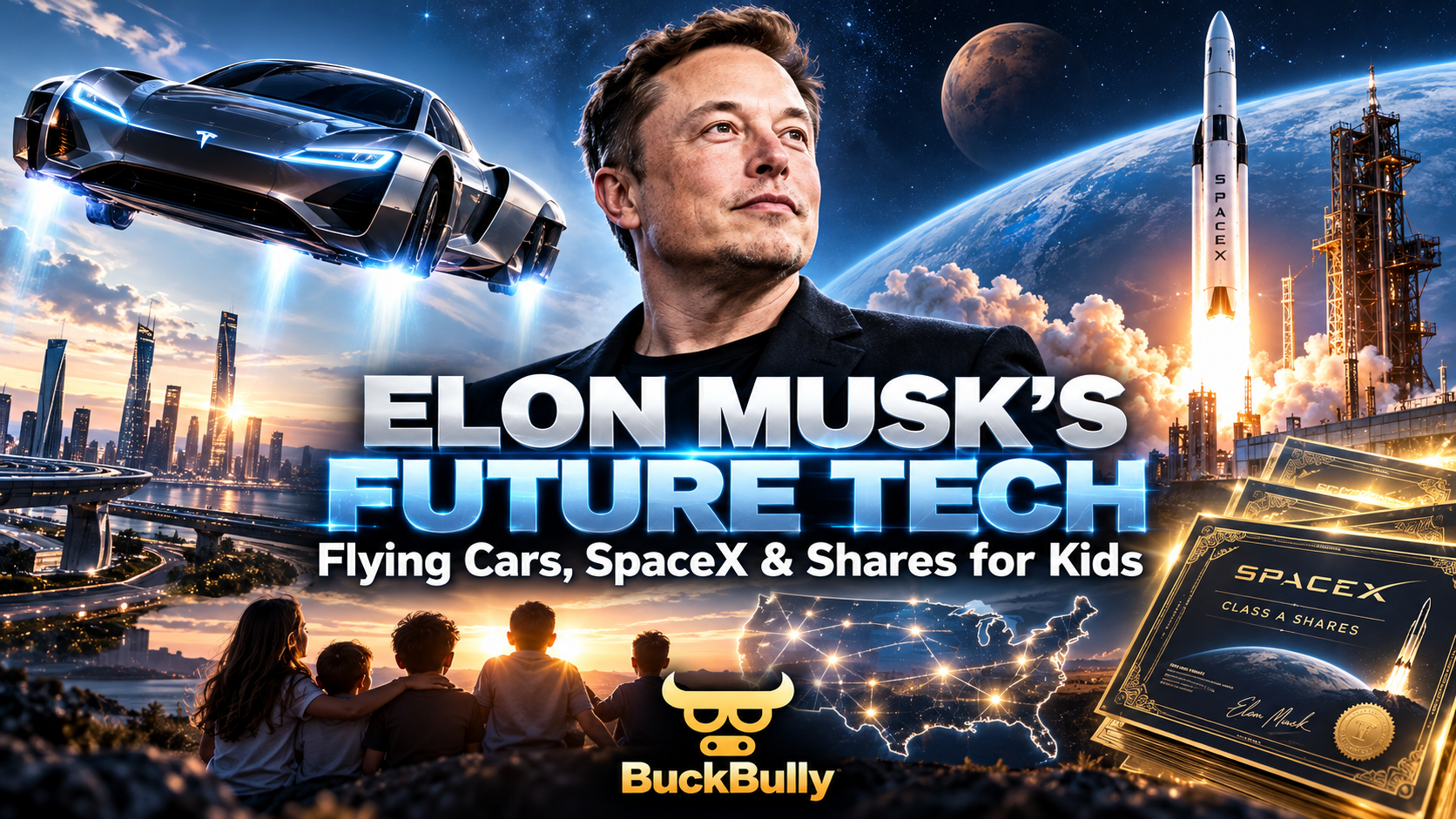
We’re talking flying Teslas, robots that could eventually handle everyday chores, rockets changing the space industry, and now a promise to give every kid in America a piece of SpaceX.
Yes, you read that right. Musk wants millions of American children to become SpaceX shareholders.
While most people are trying to figure out how to afford their next car, Musk is out here building cars that can leave the ground!
But beyond the flashy demonstrations and billion-dollar announcements, there’s a bigger story developing. Technology, artificial intelligence, transportation, and investing are beginning to overlap in ways we haven’t seen before.
And if you’re paying attention, the next generation might grow up in a completely different financial and technological world.
🚀 Every Kid in America Could Own SpaceX Stock
Here’s something you don’t hear every day.
On October 19, Elon Musk announced plans to give one share of SpaceX stock to every child in the United States in 2027.
With roughly 72–73 million American children, we’re talking about an estimated $10.5 billion stock giveaway, based on SpaceX’s recent share price of approximately $146.
That’s billions of dollars in potential stock ownership being handed to the next generation.
Not toys. Not video games. Actual ownership in a company developing rockets, satellites, and space technology.
Think about that for a second.
Imagine being 10 years old and already owning stock in a company working to make space travel more accessible.
Instead of waiting until adulthood to learn about Wall Street, millions of children could have their first investment before they even graduate high school.
But there’s a catch.
Musk has announced the plan, but he hasn’t explained exactly how it will work.
We still don’t know which children will qualify, how the stock would be distributed, whether special investment accounts would be required, or what restrictions might apply.
There’s speculation that the giveaway could connect to government-backed Trump Accounts, which are designed to encourage long-term investing for children. However, that connection hasn’t been confirmed.
And remember, stock ownership doesn’t guarantee wealth. Share prices can rise, fall, or lose substantial value.
Still, if this pledge becomes reality, it could introduce an entire generation to the importance of owning assets instead of simply spending money.
BuckBully Perspective: Imagine a generation of kids learning about compound growth, investing, and business ownership before receiving their first paycheck.
That’s a financial education worth paying attention to.
🚗✈️ Flying Cars Aren’t Just Cartoons Anymore
Remember watching The Jetsons and thinking flying cars would probably never happen in our lifetime?
Well, Elon Musk apparently didn’t get that memo.
On October 15, Tesla unveiled its long-awaited next-generation Roadster at a SpaceX testing facility in Texas.
And this wasn’t your typical electric-car presentation.
The vehicle drove upside down, launched into the air, performed a midair rotation, and landed back on its wheels.
Yes, an actual Tesla prototype left the ground.
Using powerful thrusters developed with SpaceX technology, the Roadster demonstrated capabilities that push well beyond what we’re accustomed to seeing from passenger vehicles.
The numbers are wild.
- 0–60 mph: Demonstrated in under one second.
- Top speed: Tesla claims more than 230 mph.
- Driving range: Approximately 300 miles, according to preliminary figures.
- Flight technology: High-pressure thrusters for jumping, rotating, and controlling movement in the air.
- Production target: 2028.
- Price: Premium configurations involve substantial reservation deposits, including a reported $250,000 for the thrust version.
Now, before everybody starts planning to fly over Chicago traffic, there’s something important to understand.
The Roadster isn’t currently a certified aircraft, and a spectacular controlled demonstration doesn’t mean you can legally fly one down the expressway.
There are serious questions surrounding passenger safety, roadworthiness, airspace regulations, insurance, and whether the technology can be mass-produced.
But that doesn’t erase what Tesla demonstrated.
A vehicle using rocket-inspired technology to maneuver through the air is a major engineering showcase.
BuckBully Perspective: The technology is exciting, but don’t confuse a prototype performing controlled stunts with a flying car ready for everyday commuting.
The future might be closer, but it still has some paperwork to clear!
🤖 Tesla Isn’t Just a Car Company Anymore
Here’s where things get especially interesting.
While people still associate Tesla with electric vehicles, Musk is increasingly positioning the company around artificial intelligence, robotics, and autonomous transportation.
That includes the Optimus humanoid robot and Cybercab autonomous vehicle program.
Optimus: A Robot That Could Eventually Work for You
Imagine having a robot that could assist with household chores, carry groceries, perform repetitive factory work, or help people with limited mobility.
That’s the long-term vision behind Tesla’s Optimus project.
The potential applications are enormous, particularly in manufacturing, warehouses, healthcare support, and household assistance.
But there’s an important distinction between what a prototype can demonstrate and what a commercially available robot can reliably perform.
Tesla still needs to prove that its robotics can operate safely, independently, and affordably at scale.
And then there’s the employment question.
If robots begin performing work traditionally handled by humans, what happens to wages, job opportunities, and the cost of living?
Musk believes advanced AI and robotics could eventually help create widespread abundance.
Others worry about displacement of workers and whether the financial benefits will be distributed fairly.
Either way, the conversation is no longer limited to whether robots are possible.
It’s increasingly about who owns the robots, who benefits from their productivity, and how society adapts.
🛰️ SpaceX Is Building More Than Rockets
While the flying Tesla is grabbing attention, SpaceX continues developing technology with potentially much larger economic implications.
Through Starlink, SpaceX provides satellite-based internet access, while its Starship program is designed to transform heavy-lift space transportation.
Its newest Starlink V3 satellites are intended to expand communications capacity, and the company is exploring how future orbital infrastructure could support increasingly demanding computing applications.
Consider what this means.
Internet access, communications, cloud infrastructure, artificial intelligence, and space transportation could become increasingly interconnected.
That’s a much bigger business opportunity than simply selling rocket launches.
But space infrastructure comes with challenges too: expensive hardware, regulatory oversight, orbital congestion, environmental concerns, and competition from other aerospace companies.
The opportunity is enormous, but so are the technical and financial risks.
And that brings us back to the proposed SpaceX stock giveaway.
Musk isn’t just proposing to give children a financial gift. He’s potentially giving them ownership in a business positioned across several emerging industries.
📈 What Does All This Mean for Investors?
Let’s bring it back down to Earth for a moment.
Tesla and SpaceX may share Elon Musk’s leadership and collaborate on technology, but they’re different businesses with different financial drivers.
Tesla’s stock performance depends on much more than a flying Roadster demonstration.
Investors should be watching vehicle demand, margins, profitability, competition, robotics development, autonomous-driving regulation, and the enormous cost of building new technology.
SpaceX investors face another set of considerations, including satellite revenue, launch demand, infrastructure spending, execution risk, and stock valuation.
And here’s the part people sometimes overlook:
A revolutionary product doesn’t automatically make its stock a great investment at any price.
A company can build incredible technology and still be overvalued. A big announcement can create excitement without immediately generating meaningful revenue.
Smart investors separate the headlines from the balance sheets.
That’s especially important when it comes to futuristic products that might take years to reach customers.
💰 The Bigger Question: Could Technology Change How Wealth Is Built?
The most interesting part of Musk’s latest announcements might not be the flying car.
It might be the idea of introducing millions of children to stock ownership.
For generations, many Americans have depended almost entirely on paychecks to build wealth.
But ownership creates a different opportunity.
Whether it’s stocks, businesses, real estate, intellectual property, or other productive assets, the goal is to own something that can grow in value over time.
Of course, a single SpaceX share won’t automatically fund a child’s college education or retirement.
But it could become an introduction to financial literacy.
If families use the opportunity to teach their children how companies work, what shareholders own, how risk works, and why long-term investing matters, the educational benefits could extend beyond the initial gift.
And that’s where technology and financial education begin connecting.
🐂 Final Thoughts: The Future Is Moving Fast, but Ownership Still Matters
Elon Musk has a way of making yesterday’s science fiction sound like tomorrow’s business plan.
Flying vehicles? Demonstrated.
Humanoid robots? Under development.
Reusable rockets and next-generation satellites? Already reshaping space technology.
Giving every American child SpaceX stock? Announced, with the details and execution still to come.
Not every promise will happen on schedule, and not every flashy invention will become a successful business.
But the bigger picture is worth watching.
We’re entering an era where transportation, artificial intelligence, space technology, and investing are becoming increasingly connected.
The companies developing these systems could influence how future generations travel, work, communicate, and build wealth.
And while everybody else is looking up at flying cars, maybe the bigger opportunity is understanding what’s happening financially underneath them.
Because at BuckBully, we believe the future isn’t just about using the next big technology. It’s about understanding its value and recognizing the opportunities and risks of ownership.
Be Bullish On What You Hold.
BuckBully.com — Where Collectibles Meet Markets
Disclaimer: This article is for news, education, and entertainment. It is not personalized financial advice. Prototypes, projected timelines, public pledges, and investment valuations are subject to change.